For Andy Wolf, the rather “unsexy” reality of making glasses has become something of a competitive advantage.
The Austrian eyewear company, which is celebrating its 20th anniversary this year, has built its business around designing and manufacturing in Europe.
The company operates its own production facilities and sells primarily through specialist optical retailers rather than department stores or any own-brand boutiques. But the brand has still managed to build a cult and celebrity following, with fans including Lady Gaga and Rihanna.
“The unsexy part of it is that glasses are [considered] a medical device, and people need them in the first place,” said head of creative Peter Klotz, speaking from the firm’s Berlin headquarters. “It’s not about brand; it’s about the fit on your face.”
Unlike a handbag or shoe, Andy Wolf’s frames have to fit the face as well as work with a person’s prescription, noted Klotz. That keeps the company anchored to opticians, where customers can try on frames and have them adjusted, rather than pushing aggressively into fashion retail.
That model is expensive and keeps growth limited. But as the pandemic and more recent geopolitical disruptions have exposed the fragility of supply chains, keeping production in Europe has made the business more resilient.
“It’s benefited us in the last few years, where we have had a few [successive] crises,” Klotz said. “During the pandemic we were still in a good place because we had everything in-house. And now you can see the trend with other brands — they are coming back to Europe because they saw during that time it was a struggle.”
The company has combined annual revenue of just over 20 million euros, according to its 2025 data. That remains tiny compared with the global eyewear groups that dominate the industry, but the indie brand has built a distinctive following without becoming a household name.
Founded in Austria in 2006 by Andreas Pirkheim and Wolfgang Scheucher, Andy Wolf began producing frames at a small manufacturer in Hartberg, Austria, where its production remains based. In 2010, its founders acquired the factory after it went bankrupt, when just five employees remained. Today, the Austrian site employs more than 50 people.
Six years later, they repeated the process in France’s Jura region, historically known for eyewear manufacturing, acquiring another small facility that had filed for bankruptcy. That operation has also grown to around 50 employees, according to the company.
The decision to keep European manufacturing in-house was initially as much about product as principle.
“For us as a company, it’s very important to have everything made in Europe, including the raw materials which are also sourced in Europe — metals from Germany, acetate from Italy,” Klotz said. “We are focused on having everything super close.”
Andy Wolf differentiated itself with oversized acetate frames and unusual colors at a time when smaller, more technical eyewear was dominating the market. Klotz said the company was willing to experiment and see what happened.
“I think we were fearless sometimes just to put something out there and see how it goes,” he said.

Rihanna attends the “Okja” screening at Cannes wearing Andy Wolf glasses.
FilmMagic
That approach eventually produced one of the brand’s biggest fashion moments. On the red carpet in Cannes in 2017, Rihanna was snapped wearing one of the company’s reading glasses, which had been retrofitted as sunglasses. It unleashed the teeny-tiny glasses trend and helped boost the brand’s popularity in new markets.
The brand is still a celebrity fave — most recently worn by Ethan Hawke on the red carpet of the Oscars earlier this year — but the business is not built around big endorsement deals.
For the brand’s 20th anniversary, it collaborated with Austrian contemporary artist Erwin Wurm. As an experiment, they jumped on the popularity of limited-edition “mystery boxes,” selling 20 pieces in each of five colors at 700 euros a pop.
The boxes sold out in a week, according to the company.

The collab with contemporary artist Erwin Wurm.
Courtesy of Andy Wolf
Its largest markets remain Germany, Austria, Switzerland, the Netherlands and France, followed by the U.S. and Scandinavia. The brand launched its online business two years ago, focused on non-prescription sunglasses, but that segment remains small, Klotz said.
Now the U.S. is the brand’s main growth priority. The company has established a New York office and is in the process of “rebuilding its sales organization,” said Klotz, expanding beyond the traditional New York-Los Angeles axis into regional markets including Texas and Florida.
They’re continuing to pursue selective growth rather than become a global eyewear giant.
That distinction is central to Andy Wolf’s identity. The company has no visible logo on its frames, preferring what it describes as a more “subtle design language.” Its frames are intended to be recognized by their shape, color and detailing rather than a big brand name in a way that is more stylish than simply utilitarian.
“We are more into, like, we want people to look pretty,” said Klotz.
Recent iterations have included patterns such as stripes that reference the AW initials without putting it directly on display, with the idea to make the frame distinctive enough that someone can take interest.
“People should get asked from strangers, ‘Hey, I like your frames, where are they from?’” Klotz said. The company wants to foster a sense of “if you know, you know,” he said.
The focus on fit also shapes product development. Frames can be prototyped repeatedly, with changes measured in millimeters, before they reach production. Klotz sits just steps from one of the company’s three prototypers, allowing the team to make micro-adjustments on instinct.
That proximity comes at a price.
“It’s super expensive to produce in Europe. You really need to find your customer group who really appreciate that you are still producing in Europe,” Klotz said.
The European production model has also prompted the company to look more closely at sustainability. It began measuring its corporate and product carbon footprints in 2021 in partnership with ClimatePartner, and discovered an unexpected source of emissions.
“We were like, ‘Oh, it should be super easy because everything is super local.’ And then we got the table, and then there was one huge upward spike in the table,” Klotz said. It turned out to be the brand’s aluminum cases.
The company subsequently replaced them with cardboard and switched from virgin to recycled polyester in other packaging. It also increased its use of Eastman’s Acetate Renew, with 85 percent of its collection made from the recycled-content material by the end of 2025, according to its latest responsibility report.
Andy Wolf says its product carbon footprint has fallen 38 percent for metal frames and 53 percent for acetate ones, while its corporate carbon footprint has fallen 52 percent.
Andy Wolf also runs local social projects, working with social institutions, people with disabilities and others who face barriers to entering the workforce. One initiative involved turning leftover acetate into new objects, such as bag charms, combining waste reduction with developing skills and offering employment opportunities.
The company sees these local projects as an important part of its commitment to community and maintaining its indie cred.
In the next five years Andy Wolf hopes to keep the brand “growing in an easy, in a smart, healthy way,” said Klotz. “The most important thing is that we can keep our products, and that we can have our freedom.”

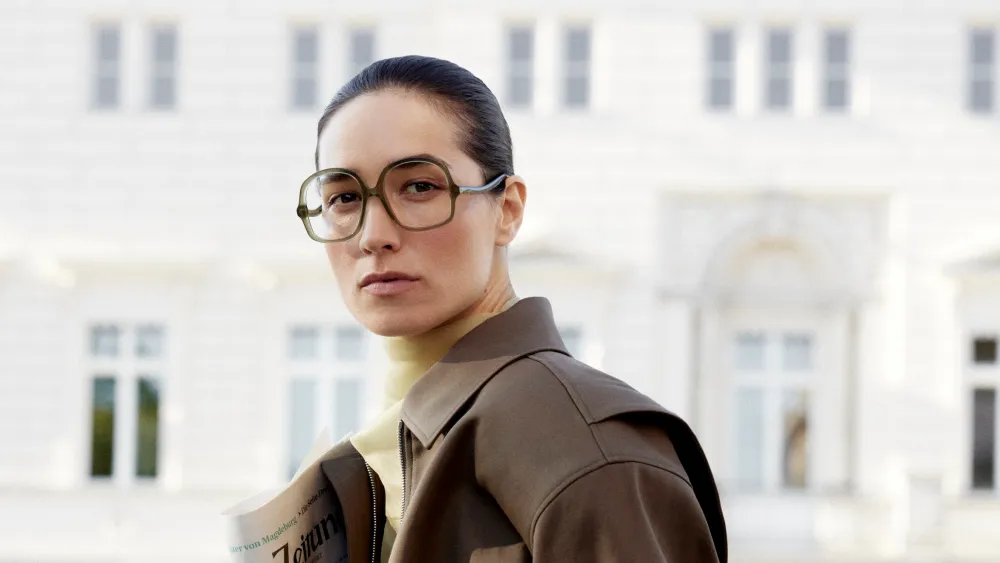
A look from the Chapter 20 collection.
Quirin Siegert / Courtesy of Andy Wolf