For fashion designer April Walker, helping to shape the early streetwear industry and watching it become a multibillion-dollar business has been “an Alice in Wonderland experience.”
The streetwear pioneer, founder of Walker Wear, is approaching the 40th anniversary of her entrepreneurial career, which began in 1987 with her custom Brooklyn boutique, Fashion in Effect. Inspired by Dapper Dan’s 24-hour custom atelier in Harlem, N.Y., which she compared to Willy Wonka’s factory, Walker wanted to create something similar for her native Brooklyn.
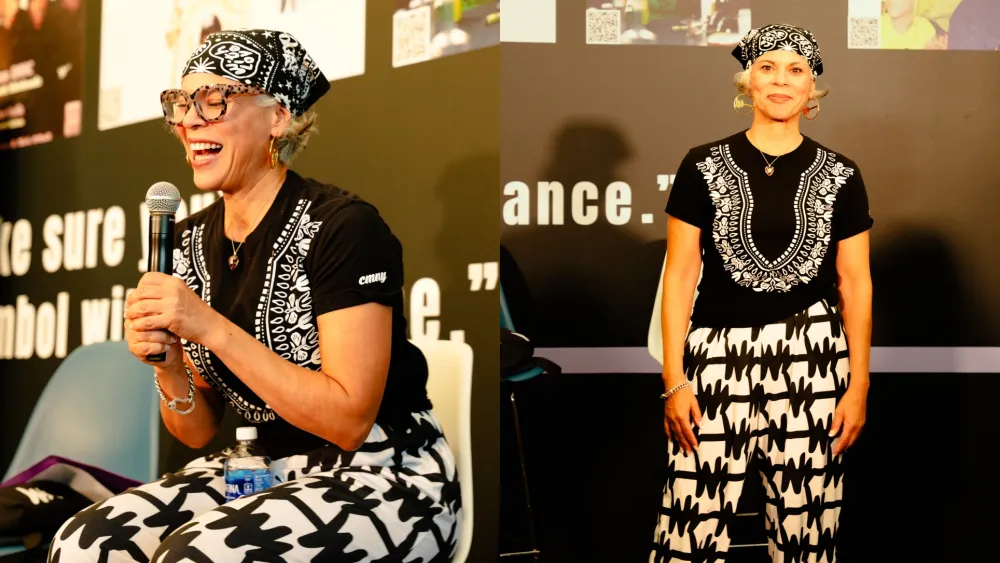
“[The 40th anniversary] milestone is huge because when I started, there was no industry,” Walker told FN/WWD while seated in her own April Walker Apparel Stu/deo at Pensole Lewis College of Business and Design. “It wasn’t called urban fashion. It wasn’t called streetwear. It wasn’t even a thing. I just started doing what I love.”

April Walker
Brandon Williams
The success of Fashion in Effect led to Walker Wear, launched in 1990. Inextricable from hip-hop, Walker Wear pieces were embraced by artists like the Notorious B.I.G., Tupac Shakur, Queen Latifah and Run-D.M.C. (D.M.C., aka Darryl McDaniels, was also a speaker at this year’s Black Footwear Forum.) A teenage Notorious B.I.G. was an early fan and remained loyal after he signed a record deal. Listening to her customers, Walker created pieces with extra leg room, low crotches and deep pockets.

April Walker and D.M.C.
Brandon Williams
With Walker’s anniversary approaching in 2027, the veteran designer is working on a book documenting her journey, due out in September 2027. That same month, Walker will be featured in an exhibit on street style at Seattle’s Museum of Pop Culture.
Walker offered a preview of the book, tentatively titled, “Necessary Rebel: A Trailblazer’s Blueprint,” Walker offered a preview of the book at the 2026 Black Footwear Forum in Detroit, the night before joining a talk with another Black streetwear pioneer, denim specialist Maurice Malone.
Walker read the ethos of her book to the crowd, explaining that she stands at the intersection of fashion, hip-hop and entrepreneurship as a woman who helped shape a global community. “Through strong storytelling and reflective Walker gems, each chapter is going to deliver lessons, challenges and actionable strategies that connect the past, the present and future,” she said.
“They’re supported by select photos, sketches and other receipts. But ‘Necessary Rebel’ is more than a memoir. It’s a blueprint for perseverance, for creativity and ownership in spaces that aren’t originally designed for inclusion.”

April Walker
Brandon Williams
When it comes to starting a business as a Black woman in today’s climate versus 40 years ago, Walker recognizes similar obstacles to securing financial backing, resources and access. While in some ways it feels like she’s back in 1987 “because of what’s going on in our country and the world,” she pointed to a stronger sense of community and cooperation. Amid the misogyny of ’87, she likened her experience to being alone on an island.
“The good news for us is that Black women in particular are some of the strongest women and most resilient women and most creative women,” Walker told FN. “When I started, I didn’t have mentors, and I didn’t have a lot of allies, and I didn’t have a lot of women next to me. The difference right now is there are a lot of Black women that are creating and making it, and we are owning our power right now.”

April Walker and Dr. D’Wayne Edwards, president of PLC Detroit.
While Walker’s been an entrepreneur for nearly 40 years, she’s been teaching for 20 years. Giving back to the next generation is paramount for her, keeping her coming back to the Black Footwear Forum at Pensole Lewis College of Business and Design every year.
“My life has been blessed, to be able to live my dreams. The good days, the hard days, and the days I want to cry — I wouldn’t trade that for the world,” Walker said. “I owe it to my community to share what I’ve gained…Being a creator, I know what that climb is like…The wins last a minute long. The adversities in the process last a lot longer. So if I can give another designer or another creative my perspective, advice or experience or knowledge that helps them to succeed — we’re only stronger together.”