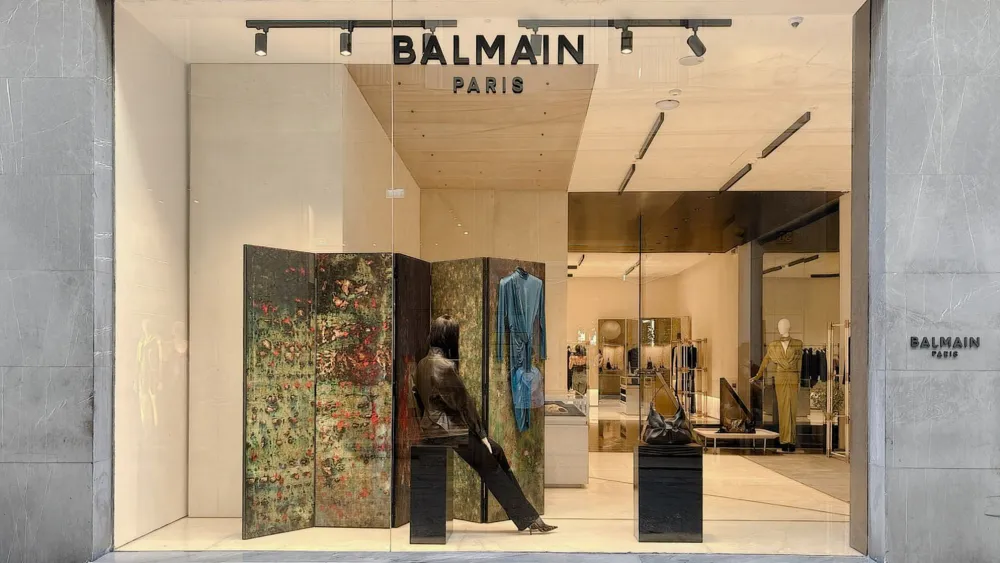
As part of its new chapter under creative director Antonin Tron, Balmain has unveiled a sleek Milan flagship at 23 Via della Spiga with a low-key Art Deco-tinged decor.
It replaces the Balmain boutique on Via Montenapoleone, which went dark over the summer, and debuts a new architectural concept.
Spread over two levels, the 3,200-square-foot unit preserves some of the existing architecture by Vincenzo De Cotiis. Meanwhile, interiors were curated by architect Andrea Faraguna under Tron’s creative direction, yielding a gallery-like ambience.
According to the house, Tron shares the belief of founder Pierre Balmain that “architecture is an integral part of fashion’s expression” and must be designed “with the same precision, emotion and attention to detail” as the products it showcases.
“The interiors balance architectural rigor with sensorial warmth,” Balmain said, listing onyx, Venetian plaster, mirrored surfaces, fiberglass, metal and glass among the materials employed, while furniture was realized with curly shearing and Japanese eggshell craftsmanship.

Inside the new Balmain boutique in Milan.
Courtesy of Balmain
The ground floor is dedicated to womenswear and accessories, with menswear and accessories on the lower level.
In an exclusive interview, Balmain chief executive officer Matteo Sgarbossa said the Milan flagship not only debuts a new look, but signals a different approach “in how we want the house to meet its clients.”
“The client has changed, and luxury retail has to change with them,” he explained. “People discover brands differently, move between physical and digital worlds and expect a much more personal relationship with a house.”
To wit: Sgarbossa said whether they encounter Balmain in a flagship or a private salon, “the environment should feel considered, distinctive and unmistakably Balmain.”
At present, Balmain operates 34 full-price stores globally, alongside 13 outlets.
Its Los Angeles and East Hampton locations offer the “private salon” concept, which Sgarbossa described as providing clients “the intimacy and personalized service of a private boutique. It is another way of rethinking what a Balmain retail space can be: moving from a traditional store experience toward something much more personal and relationship-driven.”
“Our priority is not network expansion for its own sake. It is the quality of the relationship we build with the client,” he continued. “We want to be selective about where we put our stores and thoughtful about what we create inside them. The measure of success is not how many doors we have, but whether those doors create a stronger connection between Balmain and the people we want to welcome into the house.”
Meanwhile, Milan was selected to unveil the new decor concept because it is a design capital in addition to being a fashion one. Sgarbossa described it as bringing “fashion, architecture and craftsmanship together.”
“But I don’t believe in taking one retail formula and putting it everywhere. Luxury retail cannot be one-size-fits-all,” he said. “I think this is where luxury retail is heading: from selling a product to creating a relationship. These spaces also give us the opportunity to connect with the creative communities around our clients and become part of the life of a place.
“We are taking the idea of a Balmain environment and making it meaningful to each market,” he added. “We are also becoming more agile as an organization. The store, the product, the image and the client experience have to work together.…Ultimately, we want fewer barriers between the client and the house, and more meaningful points of connection.”
Tron is scheduled to stage his second runway show for the house on Wednesday during Paris Fashion Week.

Handbags on display at the new Balmain boutique in Milan.
Courtesy of Balmain