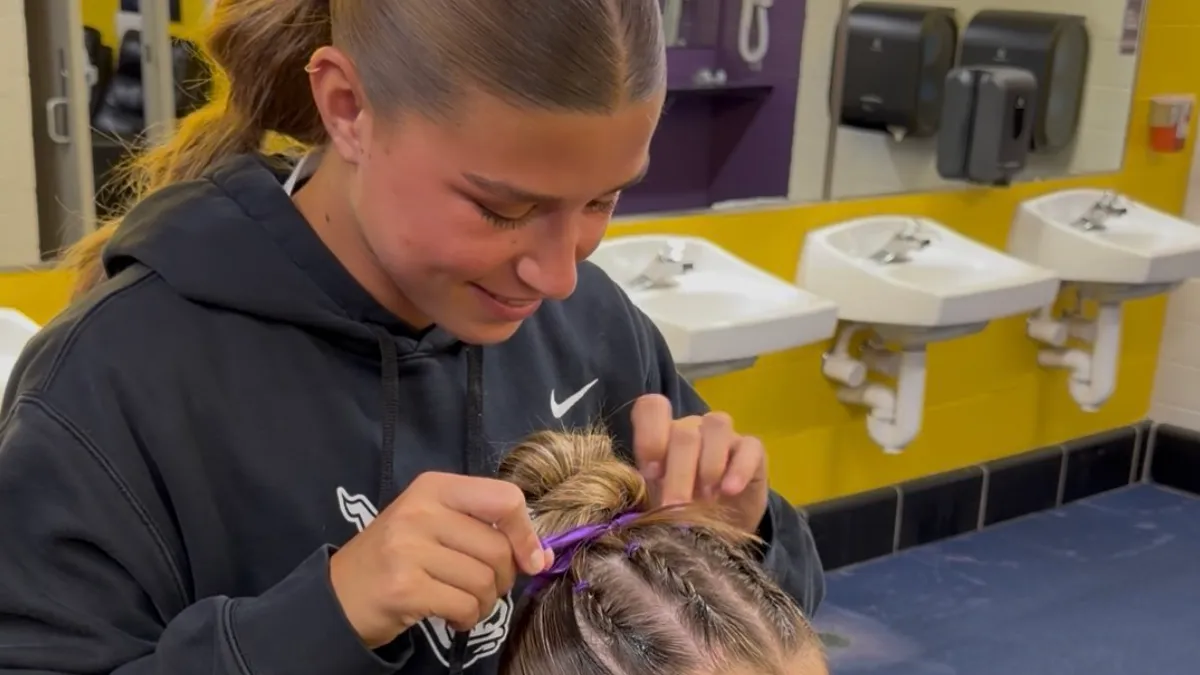
The Mavericks women’s soccer team at Minnesota State University lives by one motto: Look good, feel good, play good. And with a current record of six wins, zero losses, and one draw, the college soccer team’s mantra is clearly working. Apart from obvious skill and talent on the field, there seems to be a third key element in creating a unified team that dominates the field: their hair.
High bubble ponytails. Dragon braids and a tight bun. Color ribbons and hair ties woven throughout. These fun and whimsical creations by Mavericks soccer player Ella Huettl are a welcome sight on the field and on everyone’s screens. The 21-year-old started braiding her teammates’ hair her sophomore year for fun. But as Huettl had the social media savvy to keep posting her hairstyles for the internet to see, what started out as a small bonding moment soon became a viral sensation. “Wearing a different hairstyle makes the day feel more exciting and helps flip the switch between practice and game day,” Huettl tells Vogue. “The looks grew more elaborate [and] it has become a bonding experience that brings us together before we step onto the field. Like we always say, ‘Look good, feel good, play good.’”
Now with over 50k followers on IG alone and TikTok videos averaging hundreds of thousands (and sometimes even millions) of views, everyone is tuning in to see what she and her teammates are going to wear next.
Hair in Sports
Women are often judged more harshly than male counterparts in many aspects of life, but this is especially true in sports. According to Rachael Gibson, the writer known as The Hair Historian, any excuse to further police women on their outfit choice, nails, makeup, etc. while playing their respective sport has just been inevitable. And hair in particular, Gibson says, is often aggressively policed as it is linked to ideas of professionalism. “In the very slow process of permitting women to partake in professional sports, being able to assimilate as closely as possible to the neutral male default was understandably perhaps one less challenge to face,” she says. “So a slick ponytail, a braid, short cuts. Styles that blend in and reduce, rather than being another means to stand out.”
It wasn’t until the last couple of decades where a shift signaled some change in that thinking. She points to athletes such as Serena and Venus Williams, who wore beaded braids while competing in grand slams, and American track and field star Flo-Jo, who often wore her long, voluminous hair down while running races, as prime examples. Soccer player and activist Megan Rapinoe is synonymous with her signature cropped pink hair. Now, more women are using hair as an extension of their identity on the field.