PARIS — Climate was top of the agenda at Première Vision Paris as the global textiles fair took place in the still-sweltering 27-degree Centigrade (about 80 degrees Fahrenheit) heat following a summer marred by record heat across Europe.
“I was honestly saying to myself, ‘Is it the end of the world? The end of our industry? It’s dead, we’re all dead,’” said Diane Cabasse, founder of French slow luxury brand Diane Paris, who’s been attending Première Vision for 15 years and was struck by the smaller scale of the show, to around 900 exhibitors this season.
Cabasse said her six-year-old label is suffering from the decline in consumer spending, “like everyone else.”
“So that’s felt in the fair, who is here, who isn’t here,” she said. “On stands, I’m hearing everyone is struggling.”
While scaling back orders, Cabasse applauded suppliers’ increasing flexibility to work with smaller quantities, name-checking Gratacós and Dutel Creation as two examples.
After extreme temperatures caused an additional 7,000 deaths in France between June and July, one of the most buzzed-about talks at the fair was delivered by Arthur Keller, systemic risks and collective resilience strategies consultant, who urged sourcing professionals to collaborate to tackle the “unprecedented systemic challenges” of this period.
“Life on earth is collapsing,” he declared. “And we watch TikTok, we binge Netflix. And the best of us make some effort, yet the system goes on pretty much unchanged.”

Fall-winter’s Living Nature trend theme.
Courtesy Photo/Alex Gallosi
Keller outlined key actions from transition to systemic resilience and the elephant in the room — degrowth. “We’re here at a crossroads and either we wake up or we break down,” he warned.
At a panel by Spanish firm Ivy Decarb, a marketplace designed to accelerate the sustainable transformation of the textile industry, José Manuel Romay, head of sustainability for Inditex, said the fast-fashion giant is “progressing well” in its decarbonization targets.
“We’re not comfortable, because we’re never comfortable, but we’re where we should be,” he told WWD, noting it’s “a moving picture” given the company’s growth. Inditex has a target of reaching net-zero carbon emissions by 2040 and a 53 percent carbon reduction by 2030.
Looking back on a summer marked by drought and forest fires in Europe, Romay said the weather at Inditex headquarters in the Galicia region in Spain had been tolerable. “Where we are, northwest, it was mild,” he said.
Other sourcing professionals discussed what proved to be the hottest, scariest summer of their lives.
“One of the biggest forest fires was 15 minutes away from me in Weert, next to an airport,” said Stephen Njenga, a former C&A designer based in Belgium, who has launched a menswear start-up called Orvyx, which will feature his own line and work with other labels.
“It requires a reset,” he said of fashion’s response to the climate emergency. “2030 was a vision for most companies — now we’re nearly there, are we anywhere near the targets we had set?”
So is the industry responding?
“I don’t know how to answer that question,” said Florence Rousson, general manager of fashion for GL Events, the parent company of Première Vision. “It was terrible,” she said of the summer. “I saw a map of the planet and all the fires around the globe at the same time.”
She noted that China, still the world’s number-one apparel producer, is accelerating its transition toward carbon neutrality.
“What’s striking is their capacity for investment with enormous budgets in innovation and R&D, so they can advance very quickly. They’re on the offensive, also taking stakes in French and European companies — not only in textiles, but across industries,” Rousson said.

The Innovation & Technology focus at Première Vision Paris.
Courtesy Photo/Alex Gallosi
Among those looking for new textile customers in Europe, first-time exhibitor Dongguan Lvsheng Environmental Products Co. said increased governmental oversight is driving progress.
“It’s getting stricter and stricter. We’re a fabric maker based in an industrial zone, so all our wastewater is processed together in the industrial zone, which is audited by the government,” said sales manager Candice Liu.
Priorities among European customers include whether materials were PFA and BPA-free, while Liu reported high demand for “bio-based” fabrics, which will be the fabric maker’s next focus for innovation.
Estimating a loss of around 10 percent in revenues, due to tariffs in the U.S. where the majority of its customers — including JCPenney, Walmart and Target — are based, Dongguan Lvsheng was looking to gather European and Australian orders.
“We don’t want to keep just a single market as that’s very unstable,” Liu said, noting interest from Decathlon and Inditex for its collection of recycled jacquards, elastic and sportswear fabrics.
“Mass manufacturing’s move toward Bangladesh, Cambodia and Vietnam is leaving China with a gap of who to serve,” said Njenga, who welcomed an evolution in openness from China and Turkey’s manufacturers to work with start-ups like his.
He believes this is not just because of U.S. tariffs, but because they’ve seen the success of small European brands scaling up. Njenga said manufacturers are looking for the next Gym Shark or On Running.
China’s government is even subsidizing a Europe-based manufacturing center to deliver prototypes to customers, according to exhibitors.
“When the [Strait of] Hormuz was closed, fabrics didn’t arrive and European customers canceled orders. They’ve reacted in three months to find the solution,” said Francisco Rosas, special projects director for Positive Materials, a Portuguese fabric maker.
Representatives of Europe’s textile sector took advantage of Première Vision to call for an increased “handling fee” of around 10 euros for ultra-fast-fashion imports. But the September session confirmed its standing as a global gathering, rather than the European marketplace it used to be.
“Eighty percent of this fair is now Asia and Turkey, who compete with us Europeans,” said Rosas.
“The high-end mills are no longer here, so the high-end customers no longer come to Première Vision,” he observed, noting European mills exhibit instead at the Italian textile fair Milano Unica or at Preco Paris in July.
For Rosas, Première Vision’s September date is too late.
“In Italy in July, we saw 120 customers in three days, that’s 40 customers a day, and here, I must have seen maybe six in total,” he said.
Brands who ordered in July from his collection — which includes bio-based Bananatex or Sparxcell fabrics for “a natural shine without chemicals” — received samples ahead of the summer break. “I’m going to deliver them by the end of September, so they’ve got October, November, December to make the collection,” Rosas said.
“Who is this fair for? Who’s their customer? It’s a fair which was for the middle range,” mused Natalie Weinmann, prospective and creative consultant at Carlin Creative Trend Bureau.
“The middle class is disappearing and their labels with them. It’s always been a mirror of the world, and we can’t say that fashion is thriving at the moment,” she said. “The majority of companies are trying to save their own skins — investment is going into AI.”
Seventy-five percent of executives expect AI to help with demand forecasting, inventory optimization and cost control, according to Première Vision.
Njenga said his start-up Orvyx, which is using AI to design all the technical specifications of a product in seconds rather than days, has already picked up a luxury customer because it’s deploying the latest AI tools.

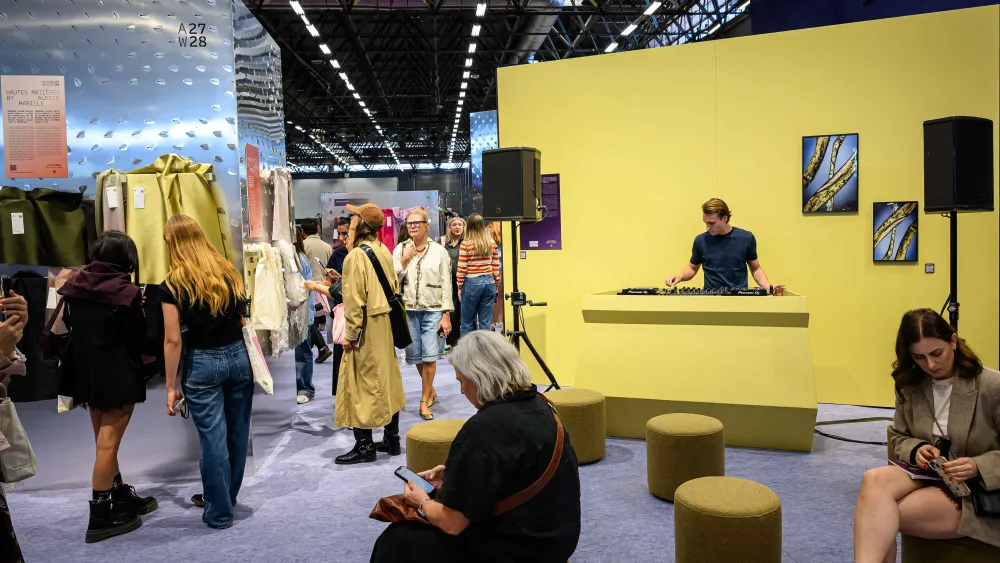
Business in the aisles at Première Vision Paris.
Courtesy Photo/Alex Gallosi
While aware of how unsustainable AI is, Njenga said: “It’s almost like survival of the fittest, if you don’t adapt you get left behind. The designer we replaced couldn’t use a computer.”
Lauren Smith, creative at Trendhub, the ready-to-buy trend division of retail consultancy BDA London, described a shift in “using AI not in a Chat GPT-way, but for data.”
But despite stifling heat in the U.K., she felt optimistic.
“[While the show] feels smaller than last time, the response at talks wasn’t doom-mongering. Action needs to come from law for people to be forced to change. Legislation is coming into play. The big one is the digital product passport over the next 18 months,” she said.
Smith named circularity as a bright spot, highlighting Reo Eco as pioneers in chemical recycling.
In trends, she highlighted “the very opposite of AI integration: the return to nature, not only as an aesthetic, because we need to,” with a focus on “human touch, a lived-in feel, a return to the earth, sensorial fabrics, washed qualities, subtle creasing, very worn.”
Première Vision debuted its Cosmetic Valley showcase featuring brands offering private label, extended its packaging exhibition space and invited designers Alexis Mabille and Victor Clavelly to curate materials. New services included Paris tours with retail specialists from Tranoi, also part of GL Events.
For January, Première Vision will spotlight India as country of honor. Aligning with the EU’s new free-trade agreement, plus a partnership with French luxury association Comité Colbert, Rousson said India has long been a sourcing destination for embroidery. Expect “a curation of handcrafted savoir-faire dedicated to embroidery — everything that’s India’s excellence.”

Cosmetic Valley showcase, a new partnership.
Courtesy Photo/Alex Gallosi