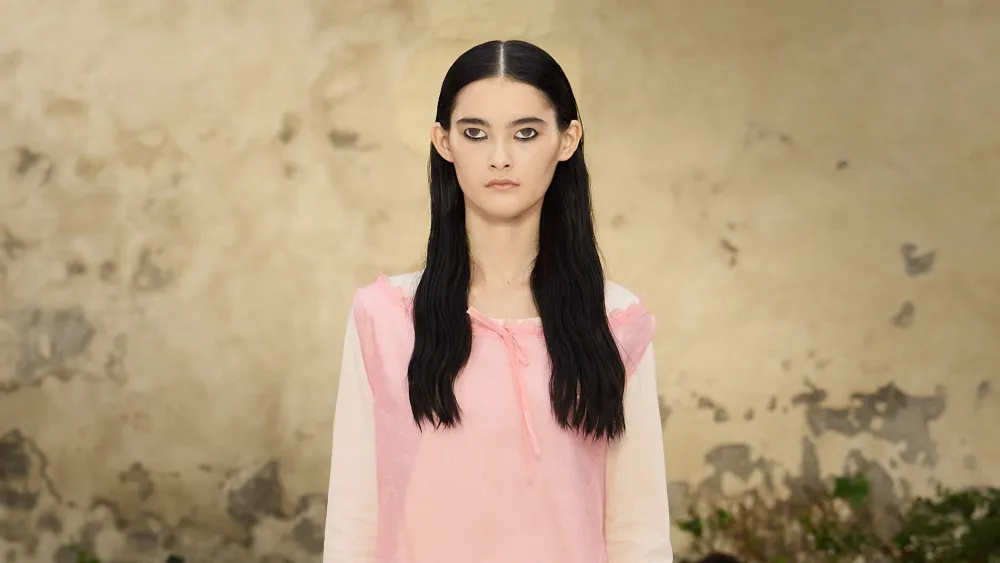
For Rahul Mishra, home is not simply a place to return to. It is a collection of details that quietly shape who we become. That idea informed “What We Carry Home,” a collection built around a woman whose sense of self is connected to inherited memories, even though she has grown up far from the place her family once called home.
For his fall 2026 couture collection, Mishra said he worked like an archaeologist. For his spring 2027 AFEW Rahul Mishra ready-to-wear, he role-played. The woman he imagined was born and raised abroad to Indian parents and knows the family house mostly through photographs. “What she knows about India is through family albums,” he said. “Somebody who lived outside of India all her life, but is very emotionally connected to her heritage, how will she showcase that in her everyday life?”
The references were intimate rather than literal: doily-like lace, gingham, landscape prints and the suggestion of a father’s striped shirt. Mishra drew on the interiors and clothing of the 1970s and 1980s, but the wardrobe remained contemporary and tailored. Silk satin, crepe de chine and linen brought a range of textures.
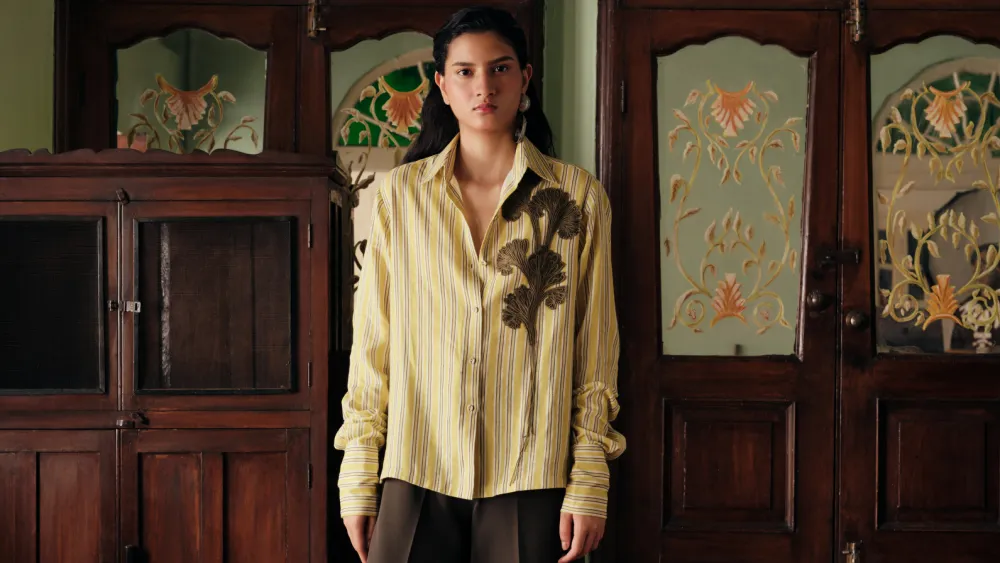
A blue gingham shirt with sheer sleeves floated over a full skirt worked in white embroidery. Butter yellow striped shirting were used in a pleated skirt, a tailored jacket and a draped top with matching trousers, recalling the yellow shirts fathers and uncles wore in so many family portraits of the era. Mishra’s signature nature-inspired embroidery appeared throughout: a striped shirt straight out of a 1970s closet carried a single sculpted flower, and a white bloom climbed up the front of a dark pantsuit. Pleats opened onto painted landscapes. Elsewhere the palette turned to black, with roses appliquéd across shoulders and sleeves, embroidery worn with shorts and fluid slips cut on the bias.
Mishra’s starting point was a stack of small black-and-white family photographs his mother handed him. His wife and creative partner Divya Mishra brought her own family archive: the small, faded Polaroids in the campaign were taken by her father on a trip to the Taj Mahal in 1972.
The collection was shot in a home in Old Delhi that Mishra imagined belonged to a family who had moved overseas yet kept the house with great care. “A lot of times we don’t realize it, but spaces make us. We don’t make spaces,” he said. “I don’t think clothing can shape and have the kind of influence a house with great character can have on people. Home is what embraces you. It’s almost like a living being, like a mother.”