Through the pre- and post-war boom, fashion gave way to style as America grew into a sharper confidence and its own dress identity. The flapper silhouette that defined the early 1920s faded with the stock market crash of 1929 and the onset of the Great Depression.
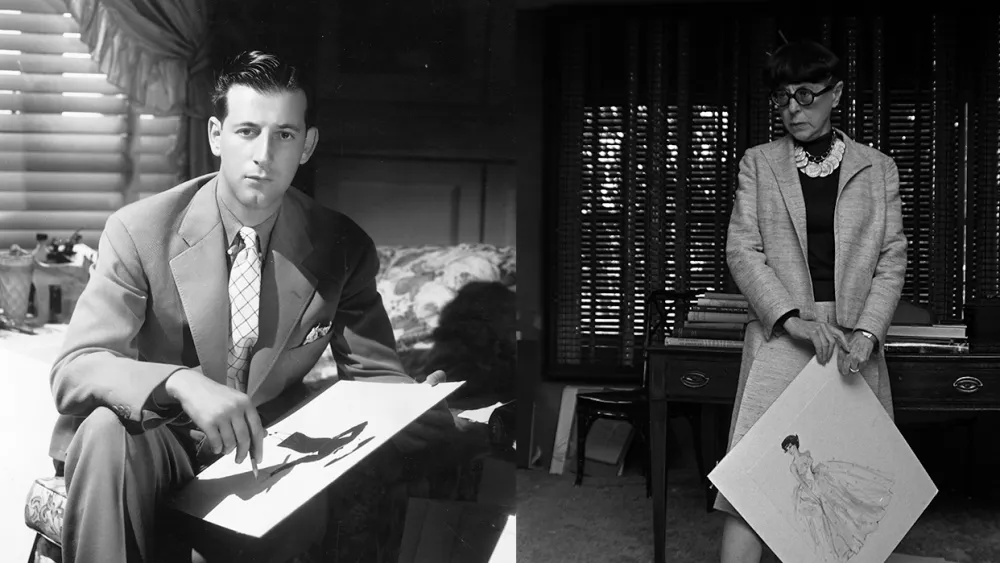
Through the 1930s, cheaper sportswear, hosiery, jewelry and accessories rose as practical purchases, while bias-cut glamour and the Golden Age of Cinema kept fantasy alive. Adrian, Edith Head, Elizabeth Hawes and Mainbocher shaped the period, while Josephine Baker, Joan Crawford, Greta Garbo, Lena Horne and Katherine Dunham carried the look outward.

Actress Muriel Evans, circa 1931 and A Cotton Day Dress, 1948.
Getty Images
By the 1940s, war rationing redirected fashion toward uniformity and utility, even as Hollywood continued to influence consumer desire. Style also became a site of resistance and cultural identity: the Zoot suit, with its exaggerated proportions and sharp theatricality, emerged as one of the era’s most politically charged looks, culminating in the Zoot Suit Riots of 1943.

Katherine Dunham and Vanoye Aikens, 1948.
Getty Images
DuPont’s invention of nylon accelerated textile innovation and ushered in the age of man-made fibers. More women entered the workforce, and practical workwear, T-shirts, house dresses, turbans, sports clothes and red lipstick became part of everyday American dress.
After 1945, fashion returned to excess as Paris revived couture and Christian Dior’s controversial New Look reset the silhouette, but American style did not retreat. California sportswear, resort dressing and play clothes gained force, while New York diverse retail sectors secured its role as a fashion capital. By 1949, when Molyneux selected 10 American houses for his Paris salon, American design had moved beyond imitation.

“50 Years of Women’s Fashion Industries,” WWD Supplement, Aug. 15, 1950.
Fairchild Archive
Here, a list of events converging around fashion from 1926 to 1950.
- 1929: The Great Depression begins on Oct. 29, called “Black Tuesday.”
- 1930: Mainbocher becomes the first American couturier to open an atelier in Paris.
- 1933: America Apparel & Footwear Association is founded.
- 1938: The Fair Labor Standards Act is passed, setting a federal minimum wage of 25 cents an hour and prohibiting child labor.
- 1941: Fashion Designers of New York/ New York Dress Institute is formed.
- 1942: The Coty Award to promote and celebrate American Fashion is created.