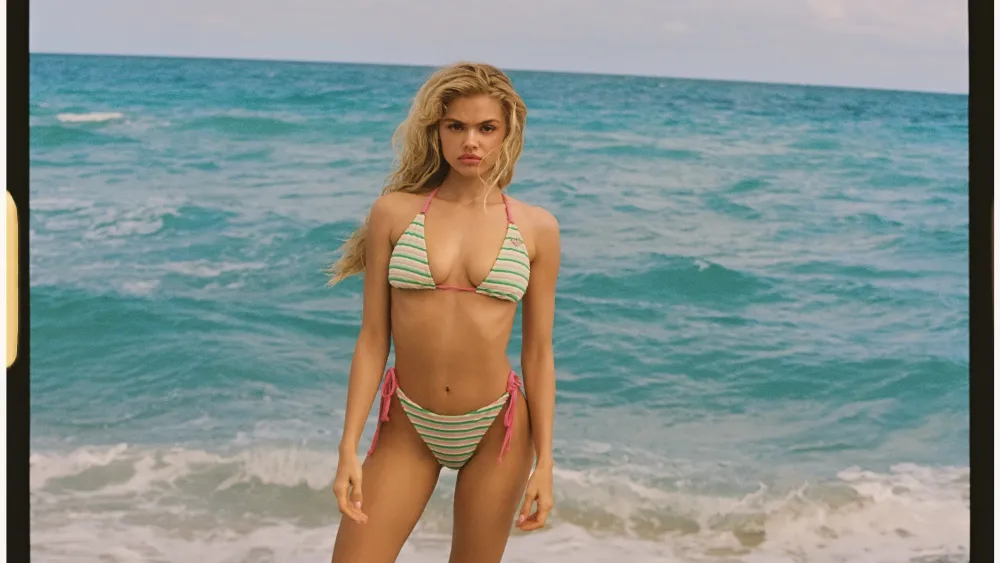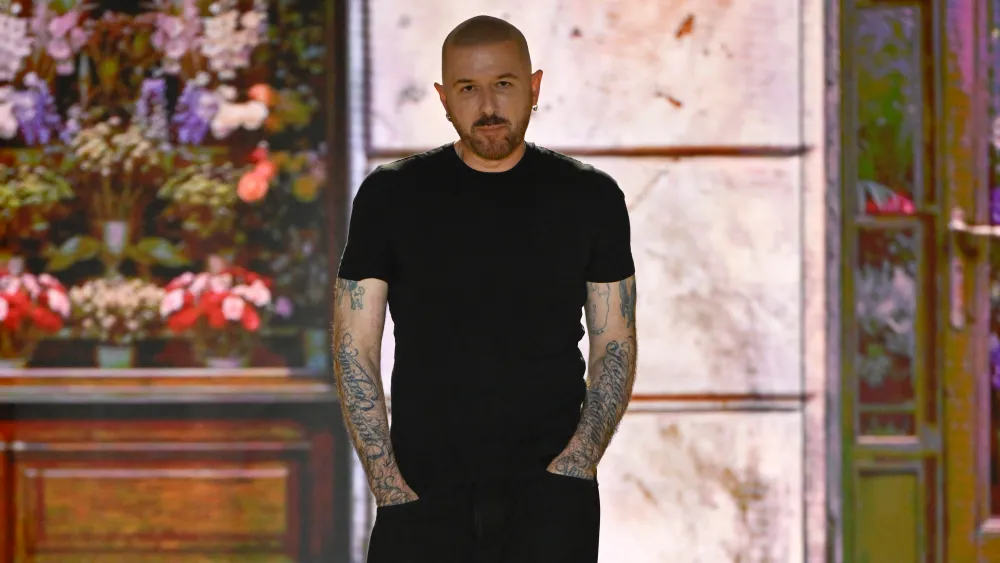
MILAN — A year after his first collection as artistic director of Gucci, Demna feels the lineup he presented Friday marked the first time his vision of Gucci was fully crystallized.
In a preview interview, Demna recalled how the first collection, “La Famiglia,” was a research into Gucci, discovering the brand.
“A year ago, I really kind of had to do it. I could never do a show [like Friday’s] back then or six months ago. I needed to take steps to kind of take apart the brand. I call it with my teams the mille-feuille of Gucci identities, layered on and on from generation to generation. And what Gucci means, let’s say, to a 60-year-old Italian man is completely different than what it means to a 25-year-old French girl. I had to undo the layers of Gucci identities to understand the essence, the ingredients of what Gucci is, because it’s an accumulated identity, and then to put these ingredients into my recipe of what Gucci can be today.”
“La Famiglia” was followed by “Generation Gucci,” an ode to the house “and what I saw in it that I liked, so I kind of tried to identify the things that spoke to me,” Demna continued. “Primavera” was his adventurous effort into body consciousness and to understand what sex appeal means “because it’s something I never did before, and at Gucci it was obvious for me that I had to learn about that.”
“Gucci Core” was really a proposition of a timeless wardrobe, he remarked. “For me, Gucci is first and foremost a product brand, not a fashion brand, but a product brand, and I feel like in our proposition in the stores to our consumers, we should definitely cover that very timeless niche of product. So basically, these were all the steps, and during each of these steps, I learned something new about Gucci.”
The latest lesson was about the aristocratic and bourgeois aspect of Gucci. “I knew it was there, but I didn’t know much about it. I didn’t grow up surrounded by this kind of bourgeois fashion, but I was always interested in it for sure. I just never worked in a company that had this as a part of its DNA necessarily, or it was not really on my menu,” Demna said, finding it very interesting as he explored it.
Demna has long staged coed shows, but given the importance of the spring show to communicate his vision for Gucci, he wanted to clearly separate the two categories.
“We have men’s stores and women’s stores. There is not that kind of coed situation in retail, and because we are going to show the visual aesthetic of the new Gucci stores that we are working on, the set is built as if it’s four different rooms in this imaginary Gucci store of the future.”
The first such store will open in Paris in about a month and a half, he revealed. “Gucci is a product brand that goes into stores. The store aesthetic kind of completes my vision in a way. I feel like my vision of Gucci should be seen in a new Gucci store. That’s a perfect place for it.”
Clarifying his vision for each category, he said that “people don’t realize that you actually do two collections for each show. I felt a bit like maybe it’s not clear that I actually do eight collections a year here, not four.”
He also said that he prefers to name his shows and collections. “I lost the count of seasons, as everybody in my teams. Season is a confusing wholesale mentality from the past, what does it even mean? In spring we’re selling puffer jackets, so I started actually with ‘La Famiglia’ giving names to every collection at Gucci because, first of all it’s a lot of work to do a collection, and I feel like it deserves a name. Like if you do an album as a musician, you give it a name. You do a movie, you give it a name, and you spend six months making clothes and bags and shoes, and it’s just spring/summer ‘27. No one knows what it is. So there is a bit of injustice.” In this case, he felt “The Store Show” would work.
Asked if he is influenced by the challenging geopolitical scenario, as has been the case over the years in his fashion, he said: “I can’t do that for Gucci, and I don’t want to do it for Gucci because it has such a huge legacy and huge cultural and social weight. Of course, as creatives, we cannot not be influenced by the world around us. I read news unfortunately every single day in the morning. I’m trying to change that, I do it less than before because I worry then and then worrying doesn’t change things, but also we need to be aware. I kind of generally know that everything is pretty awful in the world and for me Gucci has become almost an escape from that. Because I invest so much of my time and my creative energy, working here with my teams, going to factories and this is a huge company that needs a lot of love and a lot of attention, I really enjoy it a lot because it also helps me and my mind to switch off from [that worrying]. In a way, which is kind of ironic, Gucci has for me also become like a therapy. Before, I was trying to use my work also to express that because it felt very urgent. Today it still feels very urgent for me, but Gucci doesn’t need that for me.
“Gucci has survived so many things in its history. It gives me hope for everything else, everything that Gucci went through, and it’s standing there being one of the most known brands in the world with the most unique DNA and history of survival and of reinvention.”