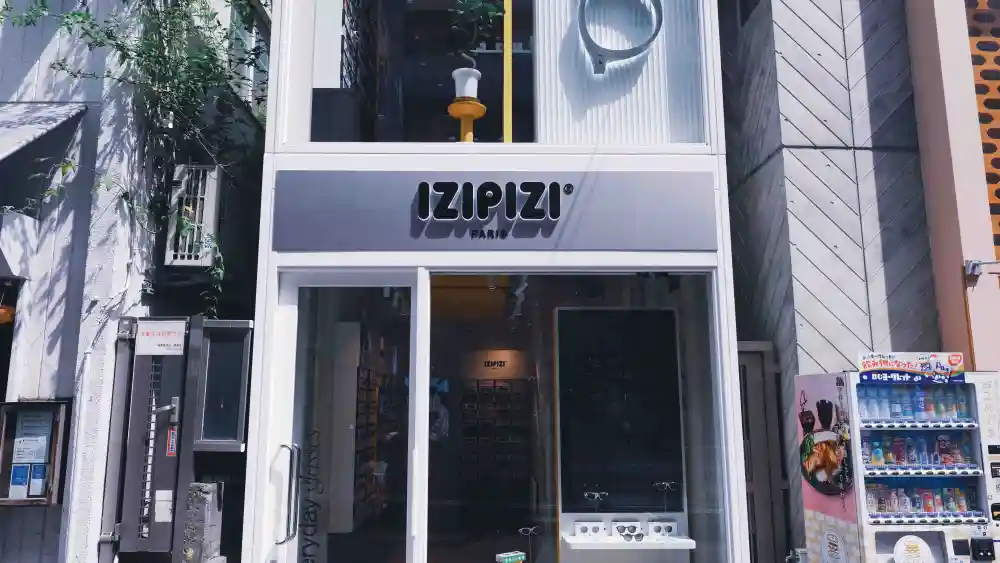
French ready-to-wear eyewear brand Izipizi is taking its next step in Asia with a stand-alone store on Tokyo’s Cat Street, its first retail location in the region, as well as part of a bigger bet on the continued globalization of its accessible, fashion-oriented glasses.
The store, which opened last July in the neighborhood between Shibuya and Harajuku, marks a new phase for the company, which has sold in Japan through local wholesale partner Ideaport for the past decade.
The brand’s Japanese business has been built through retailers including Beams and Isetan, but now it has its own address in one of Tokyo’s busiest fashion and shopping districts.
“We have always been willing to develop worldwide for Izipizi — meaning not only focused on Europe or France but selling our products all over the world,” said cofounder Charles Brun. The former investment banker studied Japanese in junior high, and has always had an affinity for the culture. “I fell in love with Japan pretty young, and it was my personal dream to open a store there,” Brun said. “But also Tokyo is such an important city in the worldwide fashion aspect, alongside London, Paris, New York.”
The timing also gives the company a way to test how its retail model will translate to Asia.
So far, Brun said, the customer mix has been evenly divided between Japanese shoppers and tourists from Europe, the U.S. and Australia.
That international audience is particularly relevant to a company whose growth strategy has increasingly been built around becoming a fashion accessories brand rather than simply an eyewear firm.
Izipizi sells nonprescription “ready-to-wear” glasses, with prices topping out at around 90 euros, putting it at a lower price point than many of the indie, fashion-oriented eyewear brands that have exploded in popularity over the past decade.
“We are a fashion brand in the optic industry,” Brun said.

Inside the Izipizi Cat Street store in Tokyo.
Courtesy of Izipizi
The company was founded in 2010 as See Concept, and spent its first six years under that name before changing it to the much catchier — and searchable — Izipizi in January 2017. The rebrand was an important pivot in helping the founders define what they wanted the company to be.
“What we noticed with See Concept is that nobody could remember it,” Brun said. “We wanted a different name that people could remember, and which was more, I would say, a philosophy of life.”
It was meant to communicate a brand that was uncomplicated and accessible, both at a product and retail level. “We want to make sure everything is easy,” Brun said. “It explains who we are and how we work. We are not snobs. We are not posh. And, in one sense, we are a bit anti-fashion because we want to be simple and easy to work with for our team, our partners and our customers.”
Plus, it’s fun. “It’s an expression we know from childhood — easy, peasy, lemon squeezy,” he said.
The idea of simplicity is part of the overall business strategy. Rather than competing directly with opticians, Izipizi has positioned its glasses as fashion accessories that can be found everywhere from fashion and design stores to museums, resorts, sports stores and children’s stores, as well as independent opticians. In the U.S., New York’s MoMa museum was one of its first customers; now the brand can be found everywhere from Bloomingdale’s to Barnes & Noble’s most upscale locations, such as the Hamptons.
The brand’s relationship with optical retailers has also evolved. Brun said opticians initially viewed the low-priced, ready-to-wear product skeptically, but collaborations and growing consumer recognition as a fashion proposition have helped boost customer requests for the line.
Today, the company is selective about where it sells. In France, it works with roughly 1,200 independent high-end optical stores out of around 12,000 nationwide — just about one-tenth of the market.
“We only work with independent high-end optic stores,” Brun said.
The Tokyo opening is also offering Izipizi a chance to develop market-specific products for the region, including lighter-tinted sunglasses for Japan. Brun said that darker lenses have a cultural association in the country, making lighter lenses necessary to appeal to local consumers.
As a result, the company has developed Japan-specific colors and transparent frames, as well as collaborated with Japanese fashion label Engineered Garments. That collaboration, Brun said, sold out in Japan within two days.
Thus the first step in Japan is giving the company a larger foothold for its wider Asia ambitions.
Izipizi already works with partners in South Korea, Singapore, Taiwan and Indonesia, where they have tested the waters with pop-ups or kiosks.
The company is currently in discussions with its Korean partner to open a mono-brand store in Seoul sometime next year, likely in a high-end mall. They are also in discussions with potential partners in the Philippines, Thailand and Vietnam and considering retail rollouts in those countries between 2027 and 2028.
“It’s really a trendy region, and it’s a growing region,” Brun said. “There are more tourists going to Asia from all over the world and, of course, the local population is also growing. So I think tomorrow the spending power will be in these countries, with all the trendiness coming from South Korea and Japan.
“So, if you’re able to be strong in Japan and [South] Korea, it helps you for Asia, but it also helps you for the rest of the world,” he said.
China, where Izipizi previously operated with a partner it ultimately dropped, could return to the mix with a new wholesale partner around 2028.
“I think you really have to adapt your brand for these markets,” Brun said of the company’s earlier experience in China. “And I think this is something we didn’t do enough at that time.”
The company is also looking beyond Asia. The U.S. is already its second-largest market after France, where Izipizi has a 10-person U.S. subsidiary, a local warehouse and around 600 wholesale customers.
Brun is now looking for its first U.S. stand-alone store, most likely in New York City. He’s currently scouting locations, and is eyeing a late 2027 or early 2028 opening.
Miami, Los Angeles, Austin and Chicago are also on the longer-term list, with the potential for as many as 50 stores across the country, he said.
But the company is wary of expanding too quickly, particularly in the U.S., where rents and operating costs can make physical retail a significant risk for an independent European brand.
“We will take our time because rents in the U.S. are huge,” Brun said. “We want the first store to be a success.”

Inside the Izipizi store on Cat Street in Tokyo.
Courtesy of Izipizi
While the company has big brand ambitions, Brun emphasizes that “easy peasy” is the core philosophy, and that the brand has grown by staying consistently product-focused rather than trying to expand rapidly.
They are also a certified B-Corp, and have made gains to switch to recycled or bio-based plastics, and are pursuing the renewed B-Corp status under the newer, more rigorous rules that were launched last year.
The company has been asked repeatedly whether it might expand into ready-to-wear clothing, but aside from caps and T-shirts for its staff, has no plans to do so.
“We’ve been thinking about [developing clothing], but there’s a brand we always loved,” he said.
Brun pointed to the Swatch on his wrist as testimonial.
“Swatch for us is a huge model. Swatch has always been doing watches, and I believe this is also why they are successful,” he said. “We had a mentor who was always telling us, ‘Stay focused, stay focused, and this is how you will succeed.’”