PARIS — From tentative strands cast between the courts of Louis XIV and King Narai of Siam to this year’s 170th anniversary of official diplomatic ties, France and Thailand have woven a dialogue of mutual admiration and creative exchanges.
How the Asian kingdom’s Queen Mother Sirikit wove these shared threads of art, attire and craft into a rich cultural and diplomatic language is explored in “Royal Thai dress, from tradition to modernity,” an exhibition opening Tuesday and running through Nov. 1 at the Musée des Arts Décoratifs.
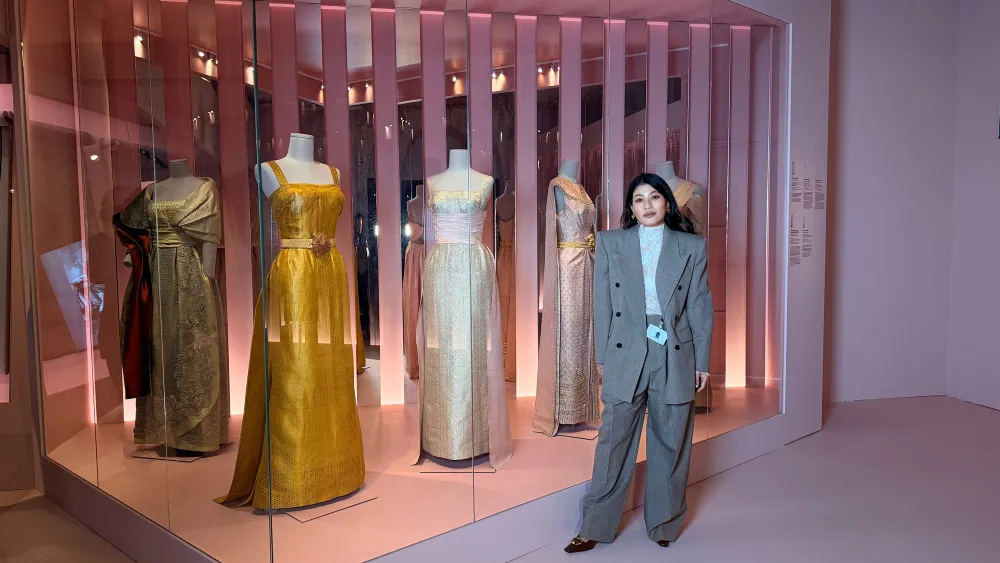
Spread over 7,500 square feet, there are nearly 200 items on display, spanning garments and accessories as well as textiles, objects and photographs. Among them is a group of royal gowns, coats and accessories usually treated as national treasures and exhibited for the first time outside of Thailand.

Outfits from Queen Sirikit’s wardrobe.
Christophe Dellière/Courtesy of Musée des Arts Décoratifs
Organized in partnership with the Queen Sirikit Museum of Textiles and the Sustainable Arts and Crafts Institute of Thaïland, it exalts the late royal as a quiet architect of cultural diplomacy but also a force who revitalized textile heritage.
Forming a dashing couple with her husband King Bhumibol Adulyadej from the 1950s until his death in 2016, the late royal used her state wardrobe to project a modern, self-confident Thai identity abroad.
For Béatrice Quette, who curated the show, “the strength of Queen Sirikit is that she made Thai fashion not traditional and folkloric but modern right away and it still is today.”
“Young or confirmed fashion designers today in Thailand still are using the vocabulary of this tradition without being [seen as] old-fashioned,” continued the curator, who also pointed out her “amazing support to craftsmanship,” exemplified with the 1976 creation of a foundation dedicated to safeguarding Thai textile arts and handicrafts.
For her granddaughter Princess Sirivannavari Nariratana Rajakanya, under whose patronage the exhibition is placed, this is also a visual biography and a homecoming to “a beloved country” where the late queen, who was fluent in French, studied and met her future husband.
“All the dresses are her timeline, her life and her [journey] from young queen to becoming the icon queen, and the dresses are like a message to tell the world what’s going on in her life,” said the young royal, who is also a fashion designer.
“How she mixed French design and Thai craftsmanship is also the story of the friendship between the two countries,” she added.

Designs from the Sirivannavari brand in the exhibition.
Christophe Dellière/Courtesy of Musée des Arts Décoratifs
Central to the exhibition is her role in building a template for modern Thai national dress, a set of silhouettes for women collectively called “Chud Thai Phra Rajaniyom,” or “Eight Styles of Thai Dress” in English. They form the bedrock of ceremonial wardrobes today and are in the process of being inscribed on UNESCO’s list of the intangible cultural heritage of humanity.
On display are silhouettes drawn from the royal household’s collections, including from the wardrobes of Queen Suthida, current sovereign King Maha Vajiralongkorn’s wife, and the princess.
Among them are a gold silk Thai Ruean Ton, a daywear suit composed of a front-buttoned blouse with three-quarter sleeves and ankle-length wrap skirt with a wide embroidered section from 1973 that belonged to Queen Sirikit, and a lilac-toned Thai Chakri, an ensemble used for grand ceremonies and named after a building blending European and Thai architectural features, belonging to Nariratana Rajakanya.
The late queen mother was lauded for adroitly blending Western style, Eastern traditions and her homeland’s rich textile heritage. One section explores her long relationship with Pierre Balmain and his successor Erik Mortensen as well as other couturiers such as Valentino Garavani, most of whom used Thai textiles at the royal’s request.
Among the highlights are a 1969 color-blocked gown by Balmain and a 1985 ensemble comprising an embroidered dress and coat in mat mii silk in an ikat motif, donated by the queen to the UFAC, the ancestor of the Musée des Arts Décoratifs, at the request of Mortensen.

Examples of Thai national dress in the exhibition.
Christophe Dellière/Courtesy of Musée des Arts Décoratifs
Beyond the garments, the exhibition pays homage to women of the court of Siam whose dress was studied by historians commissioned by the queen through archival photography.
In another segment, accessories, or rather the heritage crafts used to make them, take pride of place in an immersive installation wrapping around the room. Richly painted fans are juxtaposed with a clutch modeled after a woven basket, 18th century ceramics, a mango-shaped gold minaudière and sets crafted from niello engraving on silver and gold.
Nariratana Rajakanya also described the exhibition as something of a character study, giving insight on her grandmother’s love and understanding of art, but also her enjoyment at working with artisans around the world. Queen Sirikit was someone who “looked through love” and “through happiness,” using clothing as an expression of care — for people, culture and the country’s thriving heritage.
The exhibition’s final sections spotlight Queen Sirikit’s enduring impact on contemporary Thai fashion, where generations of designers cite her as an influence.
Translating the codes she built into the lines, drapes and fabric treatments of contemporary silhouettes are brands including Asava, Meshmuseum, Vatit Itthi — and Sirivannavari, designed by Nariratana Rajakanya.
Raised by her grandmother for much of her childhood, she described absorbing fashion almost by osmosis, sharing memories of choosing dresses for the queen’s private dinners, debates over specific shades and early exposure to jewelry-making and fabric selection.

Gowns of Thailand’s Queen Sirikit.
Christophe Dellière/Courtesy of Musée des Arts Décoratifs
Only later did she understand that she had been effectively apprenticed to a master in style — one who might have foreseen that she’d one day be a fashion designer, the younger royal said.
What Nariratana Rajakanya is keenest is to ensure that, while “everyone is a fan of Thailand,” more people become aware of its sartorial traditions and today’s designers, she said.
“And then people know about our own fashion industry,” the Thai royal continued. “It’s just opening the space.”