Fashion has a way with words, capitalizing on — and often redefining — terms to suit a particular moment. Since the 1950s, one word has been especially suited to the most celebrated figures in style: icon. The term suggests instant impact and lasting influence. Women’s Wear Daily wrote in 1998 that “icons are mirrors — a bolder reflection of society, though not always a flattering one.” Suggesting that influence is never just about style.
We would be remiss not to credit John B. Fairchild, who arrived to fearlessly, aggressively and controversially lead WWD in the 1960s, for creating a dialogue — and an opinion (he was never without one) — about the people moving within the zeitgeist. Under his direction, WWD recorded the people, places and events that gave the fashion world meaning — whether significant, trivial or somewhere in between. Through its “Eye” pages, the meaning of pop culture was transformed. WWD was not always flattering, but it was always observant, irreverent and alive with the energy of the people who, as Fairchild once noted, “make the world of Paris move, the world of New York move, the worlds of Washington, San Francisco, Los Angeles move.”
His particular vernacular — whom to photograph, discover or call out — was delivered with a candor found only in WWD. And for those following WWD then, it’s no secret that to Fairchild it was Jacqueline Kennedy or Jackie O — a nickname he coined for her — and the circle of social swans, who for him, embodied the term.
The daily became famous for launching “In and Out” lists and highlighting designers through seasonal collection ratings. The word “icon” or “iconic” was often absent from the early years of WWD’s cultural coverage, but other words were just as effective.

“If They’ve Got It, You Can Be Sure They Will Flaunt It,” WWD’s Chutzpah Ratings, April 14, 1969. Fairchild Archive/WWD
In 1969, the paper ran “If They’ve Got It, You Can Be Sure They Will Flaunt It,” a two-page feature devoted to WWD’s “Chutzpah Ratings.” The layout of photos with commentary suggested a different kind of cultural ranking, placing its subjects between the lines of the decade’s social conversation.
Below is an excerpt from the original article, which ran on April 14, 1969, and how WWD summed it up:
WWD’s Chutzpah Ratings
Chutzpah can mean unmitigated gall, nerve, sheer effrontery or guts. “All gall is divided into three parts…except when it comes to chutzpah.”
David against Goliath. Joe Namath balling before a big game. Mario Proccacino running for mayor of New York…examples of chutzpah that leave one gasping in admiration.
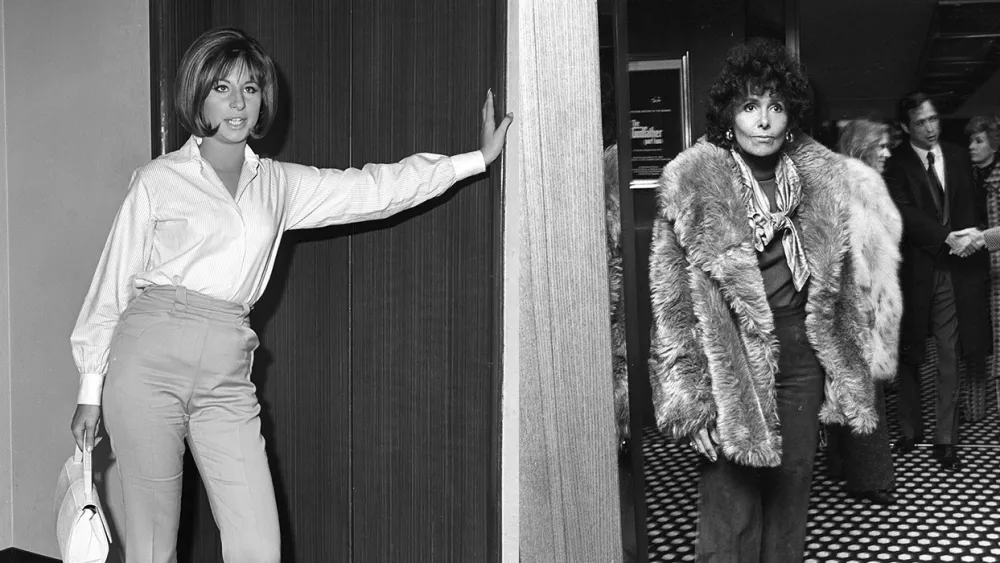
Acknowledged Queen of Chutzpah: Fashion designer Mollie Parnis, who once talked a head waiter into moving her table closer to that of the Duchess of Windsor so she wouldn’t miss a haughty syllable.

Left: Mollie Parnis attends an event at the French Consulate in New York, 1975. Right: Publicist Eleanor Lambert photographed at her New York office, 1977. Fairchild Archive/WWD
If General de Gaulle isn’t King of Chutzpah then the title must go to Saul P. Steinberg whose Leasco Corp. (assets $402 million) announced plans to take over Chemical Bank (assets $9 billion).
In awed and respectful tribute, WWD today [April 14, 1969] pays homage to the chutzpah immortals on these pages in its official chutzpah ratings.
Among those listed as “chutzpah immortals” were names that would become permanently associated with fashion and culture: Jackie O, Daddy O, Oleg Cassini, Barbra Streisand, John Lennon, Yoko Ono, Lee Radziwill, Truman Capote, Eleanor Lambert, Muhammad Ali, Halston, Estée Lauder, Valentino and Diana Vreeland amongst others like Lena Horne and China Machado, who had already risen to icon status.
At the time, few would likely have agreed with every assessment. But in retrospect, the list captured the decade that came to define the fashion, politics, philanthropy and counterculture running through the zeitgeist. Long before social media made influence measurable, WWD understood that in this algorithm, style was more than clothes. It was also about the people with the nerve to shape the world around them — and the chutzpah to make it move.