For showgoers weary of Paris Fashion Week’s nightmare traffic, flying taxis probably can’t arrive on the Uber app fast enough.
Ever the futurist and always up for a “time clash,” Nicolas Ghesquière had a few dozen windowless, wedge-shaped vehicles — with headlights and brake lights that were straight out of the ’70s — installed high over Louis Vuitton’s asphalt catwalk that ran the length of the Louvre’s massive Cour Carrée. Navigation antennas quietly blinked red on the perimeter of the vertical lanes, like a scene out of “Blade Runner.”
His set, one of the most arresting this fashion month, cued up a backstory about navigating a big metropolis — a metaphor for today’s turbulent, overheating world — unencumbered in lightweight, nearly ergonomic clothes.
“I wanted to express a sensation of simplicity — a quest for purity somehow,” Ghesquière said during a preview. “The idea of lightness, of fluidity is very important with that collection.”
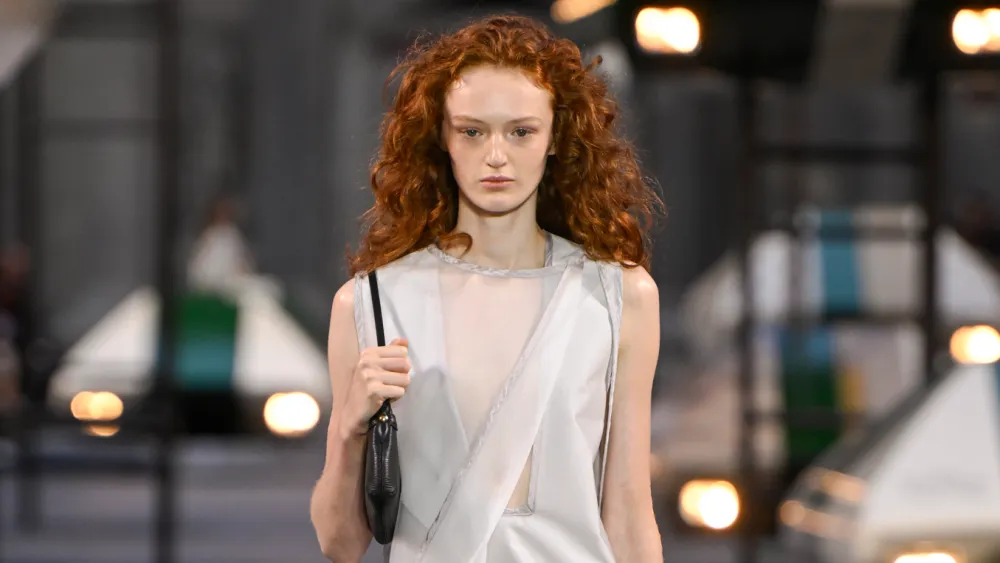
Indeed, here was one of the breeziest, most approachable and prettiest Vuitton collections in years, hinged on familiar garment archetypes — three-hole dresses, cardigans, blousons and reefer coats — in delicate, gauzy, flowing or papery fabrics that whispered luxury — and progress.
The colors were faint, the prints small or blurred, and the embroideries delicate and restrained. You found yourself leaning in when the models passed at a closer distance, discerning that some gauzy shift dresses and slinky pants incorporated mesh panels.
The surface of one of his snug leather blousons was dimpled, and most of his tailoring seemed to be executed in jersey and knit fabrics. The clothes bounced, shuddered and drifted magnificently.
It was not lost on Ghesquière — the man behind robot leggings, “Lego” shoes, industrial Neoprene tops, and stiff capes inspired by traditional kepenek — that this is unusual fashion territory for him.
“I’m a specialist in armor for a long time,” he said with a knowing chuckle.
Despite the impression of minimalism, the designer assured these quiet clothes required a maximum of research on fabrics, technical construction and engineering. From a sheet protector, he pulled out a fabric card of scarf-weight, checkered cashmere, which he employed for double-face coats.
Other double-face garments were made out of fabrics even thinner than chiffon, and Ghesquière noted that most of the coats weigh less than a T-shirt.
This show was all about defying gravity, in more ways than one.