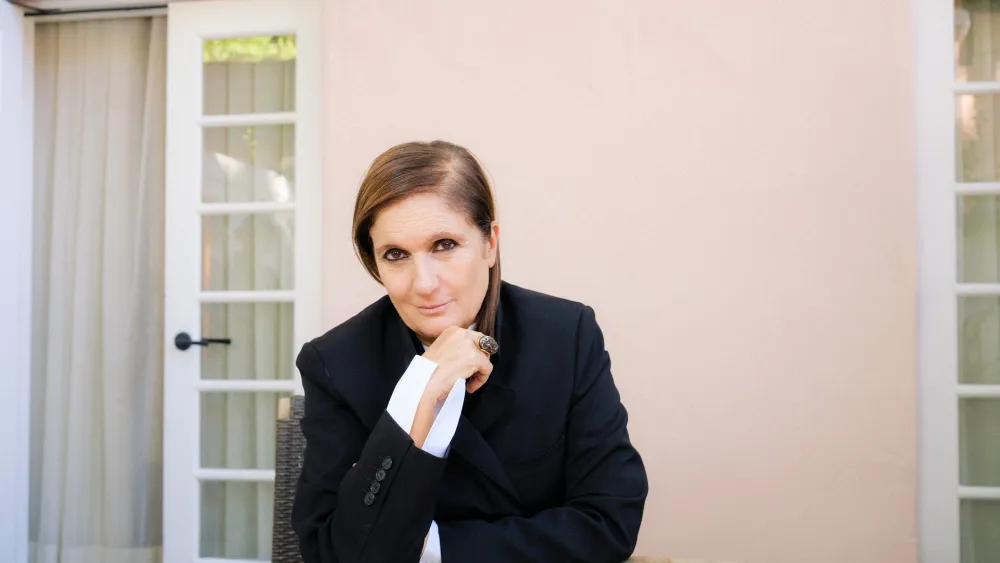
LOS ANGELES — Maria Grazia Chiuri is thinking about beginnings.
On a Thursday morning at a famed, tucked-away Los Angeles hotel, the Italian designer is reflecting on a career that has brought her back to where it all started: Fendi. The visit marks her first official trip to the U.S. since returning to the Roman fashion house.
It has been a year and a day since her appointment as chief creative officer was revealed on Oct. 14, 2025, marking a homecoming more than three decades after she first joined the company in 1989.
At 62, following 17 years at Valentino and nine at Christian Dior, where she became the first woman to lead the house’s women’s collections, Chiuri returns to Fendi with a new perspective.
“I’m a completely different person. I have different experiences, so probably I see the same place with different eyes,” she said.
Yet one lesson from her earliest days at Fendi has remained constant: the importance of collaboration. It’s a philosophy that has become central to her work, embodied in “Meno io, più noi” — “less I, more us” — a belief that creativity is a collective pursuit.
“I feel today the responsibility to give back my experience at a company where I learned so much at the beginning of my career,” she said.

Joel Barhamand/WWD
It’s a mindset she absorbed early on from the five Fendi sisters — Anna, Carla, Paola, Franca and Alda — daughters of founders Adele and Edoardo Fendi.
“When I arrived at Fendi, I was very young, and the first thing I understood was that they spoke in the plural,” she recalled. “It’s a completely different approach in a world that sometimes promotes the ego of the designer.”
That spirit has carried through Chiuri’s career, reflected in her collaborations with artists and artisans across disciplines.
“Sometimes you have this idea that there is only one person, but it’s not true,” she said, noting the ateliers, studios and craftspeople involved in transforming a concept into a finished product.
Chiuri’s return marks a new chapter for LVMH Moët Hennessy Louis Vuitton-owned Fendi, which celebrated its centenary in 2025. Following Silvia Venturini Fendi’s transition to honorary president, Chiuri has assumed creative responsibility across the house’s womenswear, menswear, accessories and couture collections.
Her creative vision for Fendi begins with a return to the archives, particularly the spirit of experimentation that defined the house under the sisters and Karl Lagerfeld.
Chiuri admires the sisters’ willingness to take risks, including their decision to enlist Lagerfeld in 1965, long before he became one of fashion’s most recognizable names.
“They were so avant-garde to choose a designer who was unknown,” she said. “Karl Lagerfeld at the time was not so famous like now.”
The willingness to experiment extended to the house’s approach to design, she said.
“I really enjoy seeing how experimental they were with craftsmanship,” she added, referring to the house’s innovative use of fur, leather and unconventional materials.
It was during those early years at Fendi that Chiuri helped develop the now-iconic Baguette alongside Venturini Fendi, the house’s then-artistic director of accessories. The handbag would go on to become one of Fendi’s most celebrated designs.

The Fendi Roma Amor Baguette.
Aedo Pultrone/Courtesy of Fendi
“We were obsessed with creating and using embroidery in different ways at the time,” Chiuri recalled, describing an effort to bring techniques traditionally associated with antique handbags into a contemporary context.
The Baguette, she said, was hardly an overnight sensation.
“At the beginning, the first embroidered Baguettes didn’t sell very much,” she continued. “It was something new, and at first, only some people understood. But step by step, people appreciated them.”
Another design from Chiuri’s early years at Fendi is making a comeback: the Croissant. The archival handbag is being reintroduced in L.A. with updated proportions, a departure from its original size. Launched exclusively at Fendi’s Rodeo Drive boutique on Thursday, the bag will receive an online prelaunch on Friday before becoming widely available on Oct. 22.
“At the beginning, it was very small, like the size of a croissant,” she said. “But we’ve renovated the design with a size that is more comfortable for life today.”
The Fendi family, Chiuri said, was fascinated with America, particularly New York, where the Baguette became embedded in popular culture through “Sex and the City.”
“We have to say that for the Baguette, ‘Sex and the City’ was very important,” she went on. “In some way, it was very important for fashion, for many different brands. We didn’t realize it in Europe. We realized it afterward, when we saw the series.”
Cinema provides a connection between Rome and L.A., two cities with rich filmmaking histories. Having dressed numerous actresses throughout her career, Chiuri sees a shift in red carpet culture toward individualized creations and, more recently, greater restraint.
“Now, honestly, celebrities want change because they want different looks,” she said. “Normally, they want something created specifically for them for a special occasion.”
She also senses a departure from the heavily styled celebrity dressing that dominates the Instagram era.
“I feel that they want a more natural look,” she said.
Chiuri is fascinated by L.A.’s vintage culture, though her whirlwind visit leaves little opportunity to explore.
Her trip also includes Fendi’s sponsorship of W Magazine’s WYouth launch party at Saddle Ranch on Thursday night, connecting the Croissant’s revival with a new generation of fashion consumers.
“I would like to go to see all the vintage stores because there is very good vintage,” she said of how she hopes to spend her downtime in L.A., noting past visits to Melrose Avenue and local flea markets.
Beyond accessories, Chiuri is exploring how Fendi’s expertise in leather and fur can translate into new materials and techniques.

Backstage at Fendi, spring 2027.
Adam Katz Sinding/WWD
“My great obsession today is to take some craftsmanship techniques that were specific to fur and leather and apply them to textiles or embroidery,” she said.
Intarsia cashmere, combinations of leather and chiffon, and silk knitwear are areas of interest, with softness and lightness informing the broader wardrobe.
Her ambitions also extend to Fendi Casa, where the designer is researching furniture, textiles, colors and materials to establish a more recognizable language for the home.
“We are working to realize a vision that is very close to the DNA of the house,” she explained.
The goal is continuity rather than reinvention every season, with pieces designed to complement one another over time.
“I think today, also for prêt-à-porter, the idea is to create a wardrobe where you can mix pieces you bought one season with pieces from the new season,” she said.
Away from Fendi, another creative undertaking occupies her attention: Rome’s Teatro della Cometa, the historic theater she and her family acquired in 2020 and spent five years restoring before reopening it in May 2025.

Teatro della Cometa
LAURA SCIACOVELLI
Designed by architect Tomaso Buzzi for arts patron Anna Laetitia Pecci-Blunt, the theater first opened in 1958. Chiuri was captivated by its founder, known as Mimì, who championed artists, musicians and performers across Europe and America.
“This place is magic, the history of the place,” she said.
Working with her daughter Rachele Regini, who oversees much of the programming, Chiuri hopes to create a space where theater, dance, music and other disciplines intersect.
“I decided to renovate the theater, which had been closed, and create a program that brings together different forms of art,” she explained.
Returning to Rome, where she was born, has also brought a renewed appreciation for her roots. After nearly a decade working in Paris, Chiuri recognizes distinct approaches to fashion in the two cities, she said: France’s treatment of fashion as culture and Italy’s deeply embedded artisanal traditions.
“I never left,” she said of Rome, with a smile.
The demands of her career have made personal balance elusive, something she hopes to change now that she’s back in Rome, where her family remained during her years in Paris.
“I have no typical day,” she continued. “I would like to find a good balance, you know.”
For all her appreciation of history, Chiuri is determined to look forward.
“I want to make new things,” she insisted.
She is particularly enthusiastic about new handbags, including the Magic, but said that creating something lasting requires patience.
“It takes time. If you believe in something, you have to keep proposing it, and step by step, people will come to recognize and appreciate it,” she said.
Asked what advice she would give her younger self at Fendi, Chiuri returned to the creative freedom of those early years: “‘Maria Grazia, please, you and your team must have the same mentality you had when you started. Don’t think about this market or that market. Do what you really love to do.’”
She intends to carry it forward, while looking back.
“If you want to move in the future, you have to know very well the past,” she said.