PARIS — Mike Amiri has embraced the Parisian lifestyle since moving to the French capital with his family three weeks ago. There’s just one snag: he has very noisy neighbors.
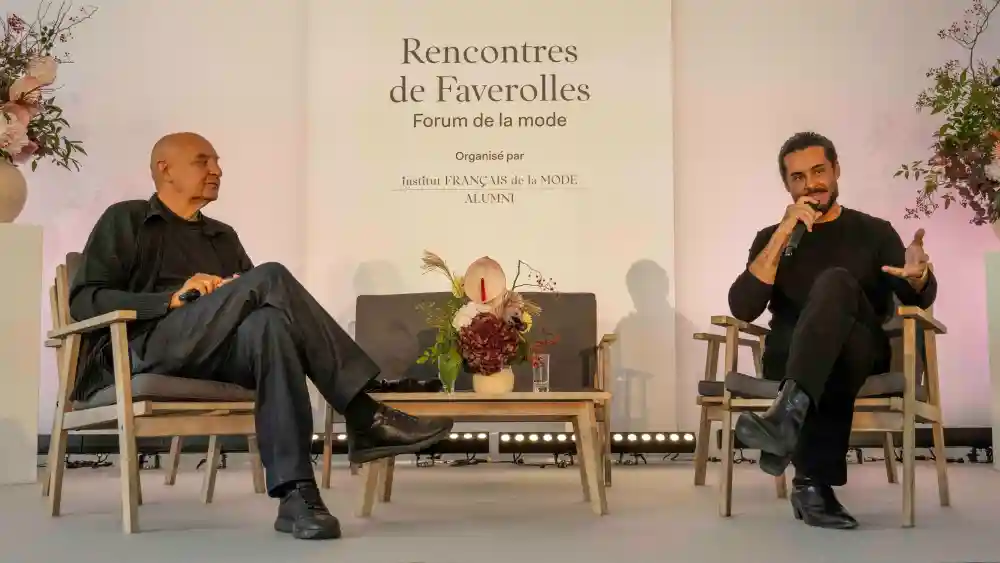
“Bonjour! I’m one of you now — so chic, so French,” the Los Angeles-born designer joked during a panel talk on Saturday at the Rencontres de Faverolles — Forum de la Mode, an annual gathering for alumni of the Institut Français de la Mode, the French fashion school which celebrates its 40th anniversary this year.
In a conversation with Pascal Morand, executive president of the Fédération de la Mode et de la Haute Couture, Amiri marveled at the differences between the two cities.
“In Los Angeles, if you want to go for a coffee, it’s a 35-minute, 40-minute drive, and that’s a three-hour coffee,” he mused.
“I’ve never walked to multiple bakeries. I’ve never known the name of the butcher. I’ve never picked up flowers every other day and put them in my house, and walked with my wife to different places, and so many different parts of the city where everyone has their own style and their own way of being,” he said.
“Being a designer, everything you see is cinematic,” Amiri added. “So it’s really given me this amazing perspective.”
Back to that noise nuisance. Amiri finally found an apartment with an elevator big enough for his three kids, but is experiencing the downside of the excitement surrounding Celine Dion’s return to the stage with a residency at Paris La Défense Arena.
“No one else lived in the building until our new roommate came in: it was Celine Dion. So now we have 350 people standing in front of our building, singing till 1 a.m., 2 a.m.,” he said. “At first it was cute, but last night at 1 a.m., my wife is like, ‘Shut up!’ But on the positive side, we have the most security of any person — like, literally, we are good.”
Amiri charmed the crowd with the story of how he founded his brand in a basement in Hollywood, dressing the likes of Axl Rose and Mick Jagger. He made his Paris Fashion Week debut in 2018, and the brand now operates 31 stores worldwide, with revenues set to exceed $300 million this year.
“It’s quite an amazing milestone for us, but at the same time, they say the top of one mountain is only the bottom of the next one,” Amiri said, noting his label was still tiny when compared with French luxury conglomerates like LVMH Moët Hennessy Louis Vuitton and Kering.

The scene at the Domaine des Oseraies.
Quentin Bertoux/Courtesy of IFM
“A leader has to look forward, and you can be happy about what you achieved, but you also understand that in the grand scheme of things, you’re nothing — you’re really not that successful. And that ideal and that ambition to grow is what’s fueled us,” he said.
Amiri credited Italian entrepreneur Renzo Rosso, whose OTB Group took a minority stake in his brand in 2019, with encouraging him to broaden his ambitions. “I’ve learned so much about thinking much bigger and being very brave, which is Renzo’s motto,” he said.
The gathering was held at the Domaine des Oseraies, the countryside home of Didier Grumbach, the former head of the French fashion federation, and his sister Sylvie Grumbach, founder of PR agency 2e Bureau.
Around 400 former students and leading industry professionals made the trek from Paris for a day of conferences and informal gatherings. Between talks, guests were invited to explore the grounds, which are filled with works of art from the Grumbach family’s endowment fund.
Chloé Laplante, one of two resident artists, showcased her sculptural use of fabrics with two outdoor installations.
Fabrice Hyber, winner of the Golden Lion at the 1997 Venice Biennial, spoke about his long-standing links with fashion and beauty going back to his student days, when he got L’Oréal to ship him 20 tubes of lipstick for a painting titled “One Square Meter of Lipstick.”
One roundtable focused on the need for France and Italy to join forces to protect their manufacturing sectors, under threat from cheap imports from China, and weakened by the downturn in luxury sales and supply-chain scandals.
Luca Sburlati, president of Confindustria Moda, said he was seeing more and more small- and medium-sized Italian manufacturers shut down.
“The ecosystem is at risk. Small companies are part of an ecosystem. If you start to lose the small ones, it’s like with a forest — in the end, you end up losing the big ones. So I think we have to be super careful, because the situation is similar to the one of the French textile industry in the ’80s and ’90s,” he warned.
Morand said he was in permanent contact with Carlo Capasa, chairman of Italy’s Camera della Moda, to coordinate their efforts. The two organizations earlier this year unveiled a joint ESG harmonization framework aimed at supporting suppliers and preparing brands for coming European regulatory requirements.
“It’s essential that we work together almost daily, because division comes easily, whereas unity is a struggle — a constant, collective struggle,” Morand emphasized.

Pascal Morand, Luca Sburlati, Pierre-François Le Louët, Virginie Jacoberger, Sergio Marini and Tristan de Witte.
Quentin Bertoux/Courtesy of IFM