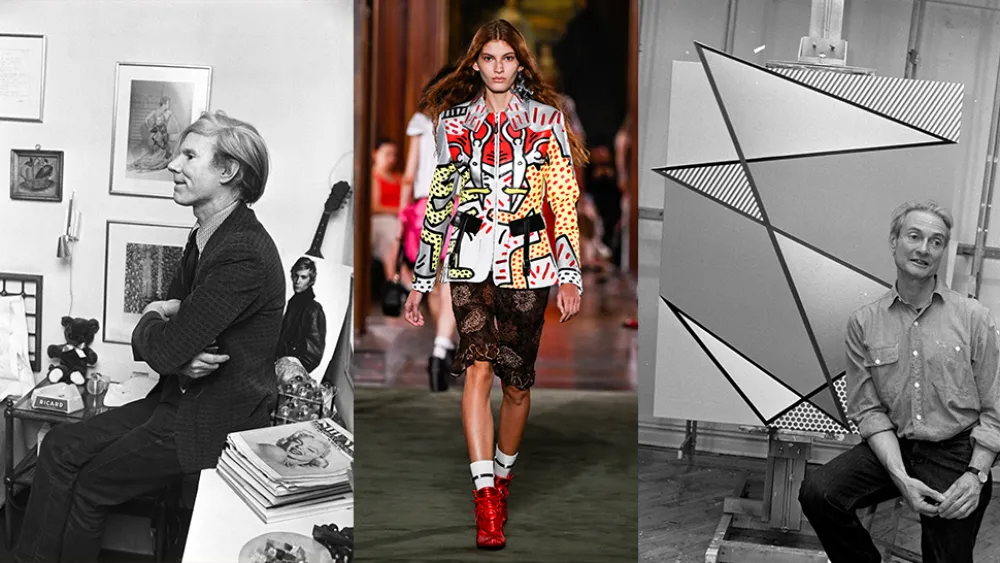
If fashion is an art form, one of its most relatable and important influences is directly connected to Pop Art and the postmodern era. But beyond the artworks, there was something equally impactful in the 1960s and beyond from the energy and creativity of the artists themselves, who moved through the galleries, studios and social circles surrounding fashion.
Among them was, of course, Andy Warhol, who once sought the attention of Women’s Wear Daily’s editors in pursuit of his passion for fashion illustration, and ultimately succeeded. Alongside Warhol, Pop Art’s influential voices included Roy Lichtenstein, Ellsworth Kelly, Claes Oldenberg and Peter Max, whose works continue to inspire.

Peter Max interviewed at his New York City studio, 1970. Sal Traina/Fairchild Archive
Sal Traina/Fairchild Archive
The era’s creative conversation also included Op Art’s Bridget Riley, as well as David Hockney and Edward Hopper. Experimental voices such as Yoko Ono expanded the possibilities of art, while photographers Gordon Parks, Richard Avedon, William Klein and Guy Bourdin held court in galleries and around the fashion crowd.
As the energy shifted toward the Lower East Side, fashion and WWD welcomed Keith Haring, Jean-Michel Basquiat, Julian Schnabel, Jeff Koons, Cindy Sherman and other artists, who brought new urgency to the city’s visual language.
As it often did, WWD captured the artists in the era. Adding opinion on the scene was T. James Jr. in this reprinted features article titled “‘Pop’ Goes the Easel,” published on Nov. 4, 1963.
‘Pop’ Goes the Easel
Throughout the years the art world has experimented creating many movements, which some have called demented. Impressionists and pointillas, Expressionist and “fauves,” Dadaists, surrealists and cubist by the droves.
And in the 1960’s, “pop” art rules the roost. Giving comic strips and billboards a swift artistic boost. Oldenburg paints hamburgers, Lichtenstein the “funnies,” Rosenquist does billboards and Martino paints bunnies.
And now the world of fashion is drawing on these fads. And painting furs and fabrics with Coca-Cola ads. By far the most outrageous creation of the pack is a painted fur by Marisol, with nude on front and back.
A California lady wore it Wednesday last at the Larry Aldrich auction. The guests were all aghast.
Photographers snapped eagerly. A man said, “Raise some hell! Cause if she wears it on the streets she might end up in jail!”

Keith Haring at the Palladium Nightclub in New York, 1985 and Billy Baldwin and a model in Williwear x Keith Haring spring 1986 sportswear collaboration, New York. Robert Kirk/Fairchild Archive
Robert Kirk/Fairchild Archive
So now at chi chi gatherings a man can wear a tie and pass it off as “pop” art. Who could bat an eye? The stars and stripes forever, a chorine doing kicks. That in the dark glows bright cerise, “Baby, kiss me quick?”
Or a lady in a ballgown, perhaps in dubious jest. With Wonder Woman and Batman emblazoned on her chest. And ads for Dr. Pepper, who could question taste? “Please don’t feed the animals” imprinted on her waist.
And axiom in the theater, “The show is on the stage,” might call for application. To “pop” art’s fashion age. Let’s hope this fashion trend reverses its tracks. Keep the nudes on canvas and not on ladies’ backs.
A sentiment clearly ignored, as art’s enduring relationship with fashion continues with the artists at the center — and at the edge — of its orbit. Through WWD’s coverage, these encounters are central to fashion’s visual record — even a sighting of Marc Chagall, Alexander Calder and Georgia O’Keeffe in the archive remains a welcome surprise.