In between the razzmatazz of celebrity arrivals, movie premieres, red carpet moments and glitzy galas that mark the annual Venice Film Festival, the Lagoon can still offer quieter yet precious occasions for contemplation.
For one, there’s still exactly a month left to indulge and savor the inaugural exhibition of Fondazione Dries Van Noten, which put the new address not only on Venice’s crowded art map but on the international cultural scene at large.
The seminal show, “The Only True Protest Is Beauty,” opened in April and will be on display at historic Palazzo Pisani Moretta until Oct. 4. It proves the Belgian designer’s commitment to celebrating beauty and sparking conversations around it even after exiting his eponymous label in 2024.

Mood board at Fondazione Dries Van Noten.
Courtesy of Fondazione Dries Van Noten
Except that instead of doing that primarily through his fashion collections, now Van Noten has enlarged the scope of his investigation to different media, as the foundation he established with Patrick Vangheluwe aims to bring together renowned names and emerging creators across art, design, architecture, photography, music, food and beyond.
This cross-pollination between creative disciplines takes center stage in the first exhibition in the lavish halls of the historic palazzo overlooking the Grand Canal.

Comme des Garçons spring 2025 with headpiece by Julien d’Ys; Christian Lacroix couture fall 2004 with wig by Fabio Petri; “Stifle” by Kate MccGwire, 2008.
Matteo de Mayda/Courtesy of Fondazione Dries Van Noten
In a conversation with WWD, Van Noten enthused about the reactions received so far. “We didn’t see those coming because of course it was our first [exhibition], so you don’t know if people are going to just come to look at the palazzo [or] be interested in the thought process and what we put together here, kind of combining arts and craftsmanship, which is quite sensitive,” he said. “The soul of the exhibition really speaks to a lot of people and very often they come out of it in an emotional way — they say [it] made them think. And that’s for me the nicest compliment we can have.”
The seeds for such feedback were planted already in the show’s evocative title, inspired by a line from American songwriter and political activist Phil Ochs, which sets the tone for this exploration of beauty as a catalyst for provocation and transformation.

“The Blind Leading the Blind #48” by Peter Buggenhout, 2012.
Matteo de Mayda/Courtesy of Fondazione Dries Van Noten
“I really stumbled on this title. The full sentence is: ‘In such ugly times, the only true protest is beauty,’” recalled Van Noten. “The moment we started this project, I used this as a working title, thinking that by the time that the exhibition was going to happen, the world would be already a better place because I thought: ‘It can’t get worse than what it is now.’” Yet when the show was ready, Van Noten kept it since it was still relevant within the global context, only opting to drop the first part of the line because he “didn’t want to work six months around an exhibition where the starting point was something very negative.”
The focal point was instead to ponder on the concept of beauty, looking at it “not as an answer, but as a question… not an escape from reality, but a way of engaging with it.”

“A Frock Will Hide All Those Sticky Out Bits He Said” by Virginia Leonard, 2026.
Matteo de Mayda/Courtesy of Fondazione Dries Van Noten
“You need beauty in your life. Everybody needs it. It can be the ray of light through the curtains in the morning when you wake up or looking at the person you love or your pets — it can be so many different things,” said Van Noten. “But I think also that beauty is not the same as pretty. It can challenge [you], sometimes you have to learn to appreciate it. And it’s also evolving — and fashion is one of the examples of it.”
Fashion inevitably plays a significant role in the showcase, which gathers over 200 objects including jewelry, artworks, photography, furniture, glassware and ceramics arrayed across 20 rooms according to instinct rather than rigid logic. For example, couture pieces by Christian Lacroix resonate with the palazzo’s frescoed interiors, while Comme des Garçons creations and headpieces by Julien d’Ys mingle with the work of new names, such as Palestinian designer Ayham Hassan, whose collection spotlights traditional embroidery and textiles to restate his cultural identity.

Comme des Garçons spring 2024 with headpiece by Julien d’Ys; portrait of Giustiniano Bullo as a child by unknown artist, 18th century.
Matteo de Mayda/Courtesy of Fondazione Dries Van Noten
Elsewhere, highlights range from Peter Buggenhout’s monumental sculpture “The Blind Leading the Blind” that visitors encounter on the ground floor to Steven Shearer’s massive portraits and metal installations by Misha Kahn unfolding throughout the halls; chairs by Moreno Schweikle, Wendy Andreu and Joris Laarman contrasting with the palazzo’s historical ones; distorted mirrors by Kiko Lopez and glassware by Alexander Kirkeby juxtaposed to ceramics by Kaori Kurihara and Takuro Kuwata, while the intricate creations by storied jewelry house Codognato recur throughout the space.
Behind‐the‐scenes videos offering glimpses into the making-of processes and brief conversations with the creators enrich visitors’ journey, further captured in a catalogue launched last week that features essays by Glenn Adamson, Ezra Babski and Alexander Fury.

Inside the catalogue of “The Only True Protest Is Beauty.”
Courtesy of Fondazione Dries Van Noten
“I’m always looking around,” said Van Noten, who curated the show with the consultancy of Geert Bruloot. “I’m always looking on my phone, on Instagram; I go to exhibitions; I read a lot; I look a lot in magazines and I love paper magazines. So I’m a very curious person, and everything that I see and gives me an emotion, I take a photo of [it], which I put in files. So the moment that we had to start to put together the exhibition, I had already a few of what I call ‘old loves’,” said the designer, citing Shearer’s photographs and creations by Lacroix, “who is really my idol.”
Hence he already zeroed in on roughly half the elements he intended to display before starting to work on the exhibition. “Then I started to put those pieces in the rooms. There was a dialogue, sometimes with the room, sometimes between the pieces themselves. And then we started to add more pieces to go together with the stories that we’re telling in every room,” he said.

“Empire Ghost Chair” by Wendy Andreu, 2024; “Hardened Mesh Chair, Red” by Seongil Choi, 2026; “The Daybed” by Nifemi Marcus-Bello, 2026; Comme des Garçons fall 2020 with headpiece by Julien d’Ys.
Matteo de Mayda/Courtesy of Fondazione Dries Van Noten
Time was among the biggest challenges, continued the designer. “We bought the palazzo exactly one year ago, so everything had to go really fast. But we said that if we managed to do four fashion shows a year in the past, we could manage also to make an exhibition in six months,” he quipped.
Van Noten highlighted the affinities between this experience and putting together collections and fashion shows, which “have always been very layered” for him.
“When I came out of fashion, I was scared I was going to miss the input of other people, because in my team, we always had very open discussions,” he said. “My team really had also to look for me because [I couldn’t] see every exhibition, every movie, every theater piece and every ballet. So they had to tell me what they thought was interesting…And what’s nice here now is that again you work together with a team, people who can help you… It’s a very interesting process and in that way it’s quite similar.”

Vase, candelabra and tumbler by Alexander Kirkeby, 2026; glassware set by Manifattura Briati.
Matteo de Mayda/Courtesy of Fondazione Dries Van Noten
Asked if he misses the fashion thrills, the designer acknowledged the perks of his new position. “I don’t miss fashion because I think I have the best possibility now. I still can look at fashion, which I always love,” he said. “I still love to follow the fashion shows and to read about everything that’s happening. I still go to the company because I didn’t stop completely, there are still things which we work on — we still design shops, we still advise on the collections, we still work on beauty and perfume. So in that way we are still connected, but from a distance which I really like,” he added, also praising successor Julian Klausner for his “excellent job.”
To be sure, standard concepts of retirement never appealed to Van Noten and Vangheluwe. “We had the idea that the moment we were going to stop, we still wanted to do something else. We didn’t stop to buy a boat and sit on my boat. Absolutely not. Because I really wanted to continue to work with people, especially with young people,” said Van Noten.

“You are what you think” by Richard Štipl, 2026.
Matteo de Mayda/Courtesy of Fondazione Dries Van Noten
This also means moving beyond the framework of exhibitions to embrace different formats to promote craftsmanship. For one, after the show’s closing next month, the foundation will stage a three-day music festival, which will also highlight both established and indie names. “We’re going to have all different types of musicians,” teased Van Noten, citing everyone from top pianists to local conservatory students and children from the neighborhood, engaged in performances of different lengths and music genres.
This will be part of the projects implemented while renovation works will be underway for 14 months at Palazzo Pisani Moretta. They are aimed at turning the private location into a public space by ensuring that its historic architecture meets current demands in terms of climate and humidity control or access for visitors with disabilities, among others.

Inside Palazzo Pisani Moretta.
Camilla Glorioso/Courtesy of Fondazione Dries Van Noten
Meanwhile, from November activities will move to a separate, 5,920-square-foot venue that is also part of the foundation. Named Studio San Polo, the space is more akin to a modern gallery, replete with concrete floors and white walls, and poised to host smaller exhibitions. At the same time, Van Noten teased the intention to work in the city and “find locations which have maybe not been used yet,” and to tie up with schools.
The foundation’s ultimate goal is to build connections not just across disciplines but also across Venice’s cultural network and communities. For the designer, the city played a key role in establishing the project. “First we thought to do it in Belgium, but then we said we lived our whole life there, so why not try to find now another country where we are happy? We always loved Italy. We thought about Rome and Florence, and then we ended up in Venice,” recalled Van Noten.

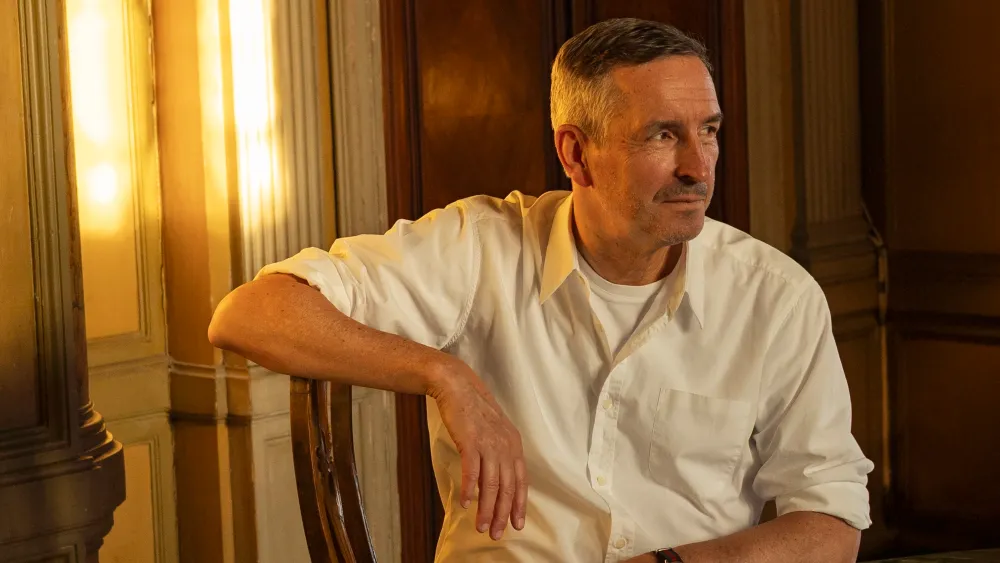
Dries Van Noten
Camilla Glorioso/Courtesy of Fondazione Dries Van Noten
He adjusted to life in the Lagoon rapidly, as he proved he already has favorite spots in town, with a preference for lesser-known addresses — such as the small Hotel Flora and Palazzetto Pisani residence — and mundane activities like grocery shopping at Rialto market or at local butchers and cheese shops.
“It’s an incredible city to live in, it’s very social,” said Van Noten. “Most people think there are far too many tourists, but you can escape them very easily… The fact that you have no cars, no bikes and no traffic lights makes a huge difference… It’s also very democratic: Everybody has to walk or take the vaporetto, you can’t hide in your limousine behind black windows,” he concluded.